
Electrical & Security Distribution: Scale Isn't the Digital Shelf
Six of 40 electrical, data, and security distributors now hold a measured DRI; Grainger leads at 66, while the group's biggest name, Wesco, scores lowest at 40.
Part of Top Distributors 2026 — the Anglera Index: North America’s largest distributors ranked, classified into six operating archetypes, and scored on the measured Digital Readiness Index.
Of the 40 electrical, data, and security distributors in this cut, only six had a public catalog we could actually measure for the Digital Readiness Index. That's not a comment on how big or well-run the other 34 are; several are among the largest companies in the vertical by revenue. It's a comment on how this channel builds its digital shelf. Wesco International, the largest company in the group at $23.5B (FY2025), has a corporate site that turned out to be brochureware with no scorable catalog attached; its real customer-facing storefront lives on a separate portal that blocks standard clients, so we measured it in a full browser session — disclosed on its scorecard — and it scored 40, the lowest mark in the cut. Rexel North America first came back with server errors, but an adversarial re-check found a live public catalog after all; it's verified live and not yet sampled, so it carries no score this edition. Among the six distributors we could actually score, W.W. Grainger leads at 66 out of 100 on the Digital Readiness Index, and even its page is a study in contrast between attribute richness and machine-matchable identifiers.
The ranking
| Rank | Company | Revenue (FY) | Archetype | DRI |
|---|---|---|---|---|
| 15 | Wesco International | $23.5B | Scale-aggregator | 40 |
| 19 | Sonepar (North America) | $19.0B (NA) | Scale-aggregator | 62 |
| 20 | W.W. Grainger | $17.9B | Scale-aggregator | 66 |
| 25 | Graybar | $12.9B | Scale-aggregator | 51 |
| 27 | Rexel (North America) | $10.1B (NA) | Scale-aggregator | not yet measured (catalog verified live) |
| 31 | Motion (Genuine Parts Company) | ~$9.0B (segment) | Branch-density | 62 |
| 32 | Winsupply | $8.4B | Branch-density | not measured (no public catalog) |
| 35 | Fastenal | $8.2B | Program-supplier | 55 |
| 51 | Consolidated Electrical Distributors (CED) | ~$5.5B (est.) | Branch-density | not yet measured (catalog verified live) |
| 54 | ADI Global Distribution | $4.78B (segment) | Catalog-native | not in this sample |
| 62 | Border States | $4.0B+ (est.) | Scale-aggregator | not in this sample |
| 76 | McNaughton-McKay Group | $2.2B (dated) | Technical-specialist | not in this sample |
| 78 | Elliott Electric Supply | $2.12B | Branch-density | not in this sample |
| 84 | Lonestar Electric Supply | $1.7B | Program-supplier | not in this sample |
| 92 | RS Group (Americas) | ~$1.09B (NA) | Catalog-native | not in this sample |
| 93 | Main Electric Supply Co. | just under $1.1B | Branch-density | not in this sample |
| 98 | Van Meter Inc. | $928.5M (dated) | Branch-density | not in this sample |
| 99 | Gresco Utility Supply | $846M | Technical-specialist | not in this sample |
| 105 | Turtle | $572M (est.) | Technical-specialist | not in this sample |
| 111 | IEWC | $500M+ (est.) | Technical-specialist | not in this sample |
| 116 | Inline Electric Supply | $456M | Branch-density | not in this sample |
| 118 | Rural Electric Supply Cooperative (RESCO) | $404M | Program-supplier / branch-density | not sampled |
| 122 | Granite City Electric Supply | $335M | Branch-density | not in this sample |
| 124 | United Electric Supply | $300M+ (dated) | Branch-density | not in this sample |
| — | City Electric Supply | not disclosed | Branch-density | not in this sample |
| — | Colonial Electric Supply | not disclosed | Branch-density | not in this sample |
| — | Crescent Electric Supply Company | not disclosed | Branch-density | not in this sample |
| — | Dealers Electrical Supply Company | not disclosed | Branch-density | not in this sample |
| — | Green Mountain Electric Supply | not disclosed | PE-rollup | not in this sample |
| — | Kendall Electric | not disclosed | Branch-density | not in this sample |
| — | Kirby Risk | not disclosed | Technical-specialist | not in this sample |
| — | Scott Electric | not disclosed | Branch-density | not in this sample |
| — | State Electric Supply Company | not disclosed | Branch-density | not in this sample |
| — | U.S. Electrical Services | not disclosed | Branch-density | not in this sample |
| — | Werner Electric Supply | not disclosed | Technical-specialist | not in this sample |
| — | Wholesale Electric Supply | not disclosed | Branch-density | not in this sample |
| — | Wholesale Electrical Supply Co. of Houston | not disclosed | Program-supplier | not in this sample |
| — | Dakota Supply Group (DSG) | not disclosed | Branch-density | not sampled |
| — | Eckart Supply | not disclosed | Branch-density | not sampled |
| — | Franklin Empire | not disclosed | Branch-density / technical-specialist | not sampled |
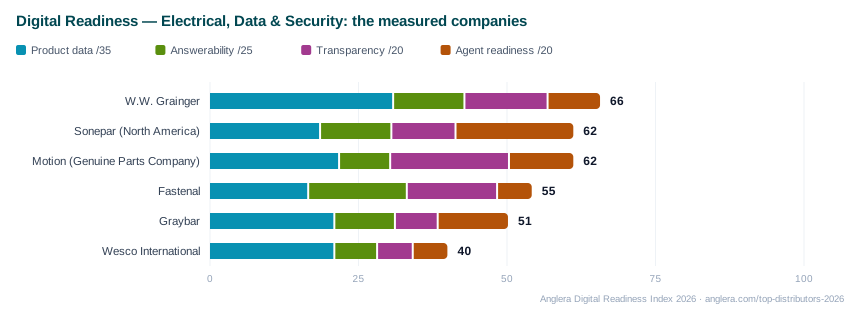
Stacked bars: the four pillars of the Digital Readiness Index — segment lengths are pillar scores, the number is the company's total out of 100.
Full index: Top Distributors 2026.
Branch density carries the field; scale sits on top of it
Count primary archetypes across the 40 companies and branch-density wins by a wide margin: 21 of 40, more than half the vertical. Scale-aggregator and technical-specialist tie for a distant second at six apiece, with program-suppliers, catalog-native operators, and a single PE-rollup filling out the rest. That split maps cleanly onto how the channel actually sells. This is a trade-counter business built on contractor relationships and local stock, and the model shows up at every size, not just among the small independents. Winsupply does $8.4B (FY2026) through more than 680 "Local Companies," each with real local equity and P&L ownership held by its branch president rather than a national brand. Consolidated Electrical Distributors (CED), at an estimated ~$5.5B, runs over 700 independently managed "profit centers" with branch-level pricing and purchasing autonomy; its old ced.com domain now redirects to an unrelated company, and the actual business lives across hundreds of separately branded local sites instead.
The scale-aggregators sit at the top of the revenue list precisely because they've built the opposite of that: centralized buying power and, increasingly, a unified digital layer over an acquired branch footprint. Sonepar is the clearest case: the world's number-one B2B electrical distributor by its own account, it posted record global sales of $37.9B in 2025 and grew digital sales 50% to $13.9B through its Spark omnichannel platform, even while its 14 U.S. operating-company banners (Capital Electric, Codale, Irby, and others) keep running locally under their own names. Graybar is doing something similar from the infrastructure side: it finished a SAP S/4HANA overhaul in 2025, opened three new STAR distribution centers built for large data-center and construction accounts, and kept up its acquisition pace with roughly its 20th deal in a decade. Wesco's fastest-growing line is data centers too, at $4.3B in 2025 sales, up about 50% year over year. And Border States, at $4.0B+, made the opposite kind of move: it left the Affiliated Distributors buying group in December 2025 after 40 years, a step only a company with its own national-account-scale purchasing volume can take on its own.
What the Digital Readiness Index found
The six distributors we could measure split into distinct profiles rather than a tight cluster, and the pillar breakdown explains why more than the headline score does. The vertical's median DRI among measured companies is 62, running four points above the index-wide median of 58.
Grainger's 66 is built on the deepest catalog in the group: a median of 47 structured attributes per sampled page, easily the richest of the six, and a product-data pillar score of 31 out of 35. But its GTIN rate on those same pages is 0%, meaning none of the sampled products carried a standard identifier a system elsewhere could use to confirm it's looking at the same item. Grainger also explicitly blocks AI crawlers, an active choice that cost it points on agent readiness (9 of 20) rather than a case of simply not having addressed the question.
Sonepar's 62 comes from almost the opposite shape: a perfect agent-readiness score (20 of 20) and an 80% GTIN rate, but a median of just 9 attributes per page, tied with Wesco for the thinnest catalog of the six. Pricing is fully gated (0% public), consistent with a business selling through independently run regional banners to contractor accounts on quote. Motion, the Genuine Parts Company industrial arm, also scored 62, anchored by a perfect 20-of-20 transparency pillar, full public pricing, and no login wall on any product page. But it also posted the widest consistency spread in the sample, a 45-point gap between its richest and thinnest sampled category, the most uneven treatment of its own catalog among the six measured companies.
Fastenal scored 55, the group's best answerability pillar (16.6 of 25) undercut by the thinnest product-data score (16.7 of 35) and no working sitemap, which dragged its agent readiness down to 6 of 20, tied with Wesco for the lowest of the six. Graybar's 51 reflects gated pricing, an explicit AI-crawler block, and the group's widest spread outside Motion (15 points), even though its product pages themselves are publicly browsable without an account. Wesco's 40 rounds out the group at the bottom: a respectable product-data pillar (21.1 of 35) on the pages a logged-out buyer sees, but a median of just 9 attributes, gated pricing, and an agent-readiness score built from what a standard client sees — which, on buy.wesco.com, is an HTTP 403.
For a buyer of this vertical's products, the attribute gap is the whole ballgame. Specifying a breaker means filtering on voltage and amperage rating and trip curve; specifying cable means wire gauge, conduit trade size, and plenum-versus-riser jacket rating; specifying an enclosure or a security camera means NEMA/IP rating, UL or ETL listing, or lens type and resolution. A median of 9 attributes, Sonepar's number, likely covers brand, model, and category, not enough to answer any of those questions without a call to a counter rep. A median of 47, Grainger's number, can support that kind of filtering directly on the page. The missing identifier is the catch: even a fully specified page can't be confidently matched to the same SKU in a buyer's own item master, or in a competitor's catalog, without one.
Where this is heading
The biggest names in this vertical are pulling in a direction the branch-density majority hasn't followed yet: Sonepar's Spark platform, Wesco and Graybar's data-center buildouts, and ADI Global Distribution's August 2026 spinoff from Resideo into a freestanding, NYSE-listed company all point toward treating a unified digital layer as core infrastructure rather than a website bolted onto branch operations. Border States leaving its buying group after 40 years to deal directly with vendors is a scale move in the same spirit. Underneath all of that, the majority of this vertical by company count is still running the branch-density model this measurement was never built to score at scale, and some of them are starting to close the gap through shared platforms rather than building their own: Granite City Electric Supply went live on Affiliated Distributors' eContent product-data platform on its webstore in mid-2026. That's likely the more common path for the long tail here than any of them building a national storefront from scratch.