
Top Specialty Adhesives Distributors 2026: PE Moves In
Four PE ownership changes hit specialty adhesives distribution in 15 months, yet the Digital Readiness Index shows the operating model barely moved.

Part of Top Distributors 2026 — the Anglera Index: North America’s largest distributors ranked, classified into six operating archetypes, and scored on the measured Digital Readiness Index.
Four of the eleven companies in this cut changed private-equity hands, added a new sponsor, or announced a take-private in the fifteen months leading into this index. Despite that, the vertical's operating shape barely moved: nine of eleven still carry "technical specialist" somewhere in their archetype, including two of the four roll-ups. The two that don't are also the two running a corporate holding-company website instead of an actual product catalog. That's the tension here.
The ranking
| Rank | Company | Revenue | Archetype | Digital Readiness Index |
|---|---|---|---|---|
| 82 | Distribution Solutions Group | $1.98B (FY2025) | PE roll-up / program supplier | 58 |
| 108 | Ellsworth Adhesives | $540M (FY2022, est.) | Technical specialist / catalog-native | not measured |
| 109 | R.S. Hughes | $527M (FY2024) | Technical specialist | not measured |
| 136 | DH Sutherland | ~$8M (est.) (recent (estimate), est.) | Technical specialist | 47 |
| — | Applied Adhesives | not disclosed | PE roll-up / program supplier | not measured (no public catalog) |
| — | Associated Industries | not disclosed | Technical specialist / program supplier | not measured (not observable) |
| — | EIS Inc. | not disclosed | Technical specialist | 60 |
| — | GracoRoberts | not disclosed | PE roll-up / technical specialist | not measured |
| — | Integral Products | not disclosed | Technical specialist | not measured |
| — | Krayden | not disclosed | PE roll-up / technical specialist | not measured |
| — | Rudolph Bros. & Co. | not disclosed | Technical specialist | not measured |
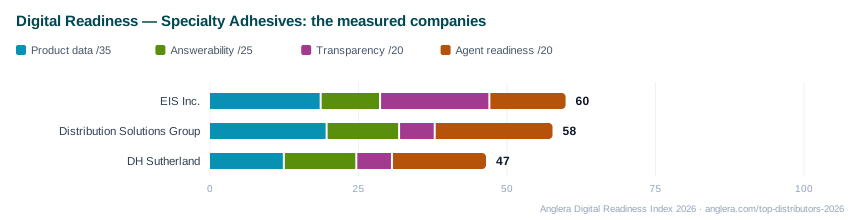
Stacked bars: the four pillars of the Digital Readiness Index — segment lengths are pillar scores, the number is the company's total out of 100.
Ranks come from the full Top Distributors 2026 index; NR means the company doesn't disclose revenue and so isn't placed on that list. Eight of the eleven are privately held and publish no top-line number, which is normal for this vertical and not a signal of size.
A buying spree that hasn't changed what's being bought
The ownership churn is concentrated and recent. Distribution Solutions Group's majority owner, LKCM Headwater Investments, agreed on July 15, 2026 to take the company fully private at $35.00 a share, an 81% premium to where the stock traded before the announcement. Applied Adhesives changed PE sponsors for the second time in a decade when Bertram Capital bought it from Arsenal Capital Partners in April 2025, citing Applied's "proven M&A playbook" as the reason to keep going. GracoRoberts ended an eleven-year run under CM Equity Partners with a new strategic investment from Tinicum, L.P. in July 2026, adding a Miami hub via the Sky Mart acquisition the same year. Krayden, already under its second sponsor (Quad-C to Audax), added Aerospace Reliance and the Europe-based CAPLINQ in June 2025.
What's notable is what the sponsors are buying. GracoRoberts has made six acquisitions in seven years — Able Aerospace Adhesives, Silmid, SkyGeek, Pacific Coast Composites, Sky Mart — and every one still trades under its own name. Krayden's PE owner, Audax, frames the customer base around "specialized, no-fail applications" requiring technical sales support, not a generic distribution playbook. Both carry technical specialist as a secondary archetype alongside PE roll-up. DSG and Applied Adhesives don't: DSG's own site is investor brochureware with no catalog, and Applied runs a consultative site organized by adhesive chemistry and market segment, reflecting a strategy built on private-label lines (ASURE, Adhezion, Infinity Bond) and installed equipment service rather than catalog breadth.
The other seven never left family or founder hands and read almost identically: certification-first operators competing on capability, not footprint. Integral Products holds AS9100D, ISO 9001, and NADCAP 7202 out of one 61,500-square-foot Harbor City facility. Rudolph Bros. & Co. runs a climate-controlled, H2-rated hazmat facility with minus-20°F cold storage for freezer-stable structural adhesives. DH Sutherland sells temperature-sensitive aerospace adhesives out of an ISO7 cleanroom under DDTC export certification. EIS Inc. runs six fabrication facilities converting process materials into engineered parts. None of that is an asset a roll-up erases quickly, which is probably why the PE-owned entrants keep buying more of it rather than replacing it.
What the Digital Readiness Index actually found
Only three of the eleven were measured for the Digital Readiness Index, and the other eight split across three reasons that aren't equivalent. Six — R.S. Hughes, Ellsworth Adhesives, GracoRoberts, Integral Products, Krayden, Rudolph Bros. & Co. — simply weren't in the measured set this cycle. Applied Adhesives has no public catalog to measure: its site is consultative, not e-commerce. Associated Industries has a public catalog with open specs and no visible price, but its pages are not observable to our measurement pipeline — a note about the page's construction, not the company.
Of the three, EIS Inc. leads the vertical at 60, with Distribution Solutions Group at 58 and DH Sutherland at 47 — a vertical median that lands exactly on the index-wide median of 58. But the three get there by completely different routes, and the pillar breakdown is the actual story.
EIS wins on commerce transparency: 18.4 of 20 points, driven by a full B2B storefront that shows price on 80% of sampled products and stock status throughout, plus a GTIN on a fifth of them — real self-serve commerce. But EIS is weakest on buyer answerability (10 of 25) and machine readiness (13 of 20): despite the working cart, its pages carry no product structured data at all, so a crawler has to parse rendered HTML instead of reading a clean feed. Its median attribute count of 18 is the highest of the three, but its consistency spread of 24 points is also the widest — EIS treats some product lines far more thoroughly than others.
Distribution Solutions Group sits almost opposite. Its machine and agent readiness score is a perfect 20 of 20 — sitemap coverage, product structured data, and open crawler access are all in place, and an unaddressed AI crawler policy costs nothing here since silence permits access rather than blocking it. But its commerce transparency pillar is the worst in the vertical at 6 of 20: zero percent of sampled pages showed a price or a GTIN, which tracks with the group's own corporate domain having no catalog — the real commerce sits one layer down, at Lawson Products and its sister operating companies.
DH Sutherland is the outlier in a different direction. Its catalog is public and filterable by manufacturer and product type with no login wall, and its consistency spread of just 1 point is the tightest in the vertical — every product page reads almost identically. The problem is what's on those pages: a median of 4 structured attributes, less than a quarter of EIS's 18. A buyer of aerospace-grade adhesive needs to filter on cure temperature, working time, shear strength, freezer-stable shelf life, and certification level. Four attributes doesn't leave room for most of that, and DH Sutherland's pages end in a request rather than a price, so the remaining answers come from a person, not the page.
Where this settles
Four ownership changes across eleven companies in fifteen months is a fast churn rate for a vertical this small, and the language every new sponsor uses — "proven M&A playbook," more bolt-ons — suggests it isn't finished. What the data argues against is the assumption that PE ownership flattens these businesses into generic distribution. The certifications, cleanrooms, and cold-storage facilities that define this group don't transfer with a change of sponsor, and the two roll-ups that kept a technical-specialist identity, GracoRoberts and Krayden, look more like the vertical's median company than the two that didn't. The open question is whether that holds as ownership turns over, or whether the next deal optimizes the catalog the way DSG's corporate site already reads: built for a crawler, not for a buyer with a price question.