
Top Safety Distributors 2026: Programs Beat Catalogs
Grainger and MSC lead a Safety vertical where seven of twenty distributors sell managed PPE programs and revenue size stops predicting digital shelf scores.
Part of Top Distributors 2026 — the Anglera Index: North America’s largest distributors ranked, classified into six operating archetypes, and scored on the measured Digital Readiness Index.
Wesco International, the largest company in this vertical by revenue at $23.5B (FY2025), scored a 40 — the lowest measured number here, and one that took a full browser session to obtain because its catalog blocks standard clients — while MSC Industrial Supply, roughly a sixth its size, finished one point behind the vertical's best measured score. Seven of the twenty companies here run some version of the same play: bundle PPE into a managed program sold on compliance risk, not unit price. That concentration is what this data set is actually about.
The vertical, ranked
| Rank | Company | Revenue | Archetype | DRI |
|---|---|---|---|---|
| 15 | Wesco International | $23.5B (FY2025) | Scale-aggregator | 40 |
| 20 | W.W. Grainger | $17.9B (FY2025) | Scale-aggregator | 66 |
| 31 | Motion (Genuine Parts Company) | ~$9.0B (FY2025, segment) | Branch-density / scale-aggregator | 62 |
| 32 | Winsupply | $8.4B (FY2026) | Branch-density | not measured (no public catalog) |
| 35 | Fastenal | $8.2B (FY2025) | Program-supplier / branch-density | 55 |
| 40 | Airgas, an Air Liquide company | $7.5B (FY2024, NA, est.) | Scale-aggregator / branch-density | 46 |
| 47 | White Cap | $6.1B (FY2025) | PE-rollup / branch-density | not sampled |
| 65 | MSC Industrial Supply | $3.77B (FY2025) | Program-supplier / catalog-native | 65 |
| 83 | Vallen Distribution | $1.9B (FY2021, NA, est.) | Program-supplier / technical-specialist | not sampled |
| 90 | Global Industrial Company | $1.38B (FY2025) | Catalog-native | not sampled |
| 126 | Martin Supply | $279M+ (FY2024) | Branch-density | not sampled |
| 131 | Mallory Safety and Supply | $200M (FY2021, est.) | Branch-density | not sampled |
| — | Aramsco | not disclosed | PE-rollup / branch-density | not sampled |
| — | EWIE Group | not disclosed | Program-supplier | not sampled |
| — | Magid Glove & Safety | not disclosed | Program-supplier / catalog-native | not sampled |
| — | McMaster-Carr | not disclosed | Catalog-native | not measured (no public catalog) |
| — | SPI Health and Safety | not disclosed | Branch-density / PE-rollup | not sampled |
| — | Stauffer Glove and Safety | not disclosed | Branch-density / program-supplier | not sampled |
| — | Würth Industry North America | not disclosed | Program-supplier / branch-density | not yet measured (catalog verified live) |
| — | Total Safety Supplies & Solutions | not disclosed | Program-supplier / catalog-native | not sampled |
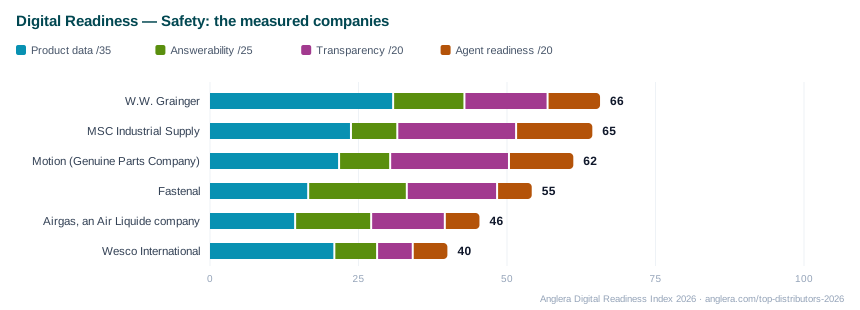
Stacked bars: the four pillars of the Digital Readiness Index — segment lengths are pillar scores, the number is the company's total out of 100.
Ranks and revenue come from Anglera's full Top Distributors 2026 index; scores use the Digital Readiness Index methodology. Six of twenty companies here were measured; the rest sat outside this round's sample. Three unmeasured companies hit distinct obstacles worth separating from the rest: a live catalog verified at Würth but not yet sampled, and no reachable per-product catalog at Winsupply and McMaster-Carr. Neither is a statement about how the company runs its business.
Program suppliers own this vertical
Program-supplier is the primary archetype for seven of the twenty companies here, more than any other model, ahead of branch-density (six) and scale-aggregator (three: Wesco, Grainger, and Airgas). The logic is category-specific: safety and PPE purchasing carries OSHA compliance exposure a purchasing manager often can't own alone, so vendors sell the program upward instead of the SKU. Arbill's positioning made this explicit while it still ranked in this cut: its EHS Managed Services business was sold "to CFOs on risk-cost avoidance rather than to purchasing managers on unit price," and its 2025 TruSense wearable proximity-sensing system extended that into plant-floor safety. Würth's Northern Safety & Industrial division bought ORR Safety in 2025 for a similar reason, a $125M-plus PPE distributor expanding private-label programs into rail, automotive, and government accounts. Magid Glove & Safety pairs the model with in-house manufacturing at a 700,000-square-foot Illinois campus, private label alongside 700-plus third-party brands.
Branch-density is the second most common model, which tracks with how safety products physically move: gloves, respirators, and gas cylinders are inventory customers want close by, not shipped overnight from one national hub. Mallory Safety and Supply built a 16-to-22-branch network across nine Western states through 20 acquisitions since 2005, self-funded, no private equity, no stock listing. SPI Health and Safety took a similar path, 24 acquisitions since 1972 to reach 18 Canadian locations.
Scale-aggregator status belongs to Grainger, Wesco, and Airgas for a reason: each runs national-account and purchasing scale a regional operator can't match, whether that's Grainger's large distribution centers, Wesco's national business units, or Airgas's nearly 800 branches and fill and production plants. Private equity has a foothold but hasn't remade this category the way it has elsewhere in the index; only Aramsco and White Cap carry pe-rollup as a primary label, and White Cap's February 2026 combination with Colony Hardware, following roughly 17 tuck-ins in 2024 and 2025, is the more active of the two.
What the Digital Readiness Index found
Six companies were measured, and the spread between them is more instructive than any single number. Grainger's 66 leads, built on the strongest product-data pillar here (31 of 35) and full public pricing, but it's also the only company that explicitly blocks AI crawlers rather than staying silent. Under this methodology silence scores full marks, so Grainger's agent-readiness pillar (9 of 20) reflects a stated policy, not an oversight. MSC sits one point behind at 65, with a perfect commerce-transparency score (20 of 20) and the best identifier match rate, 75% GTIN coverage against Grainger's zero, even though its buyer-answerability pillar (7.8 of 25) is the second-weakest of the six.
Below that pair, revenue stops predicting score. Motion, the GPC subsidiary heading toward its own public listing under the planned NAPA and Industrial split, scores 62 with every sampled page fully public: price, availability, complete spec table, no login. But its consistency spread of 45 points is the widest in the sample, more than three times Grainger's 14, meaning Motion's catalog treats some categories like a modern storefront and others like an afterthought. Fastenal, at 55, inverts the usual shape: its buyer-answerability pillar (16.6 of 25) is the strongest of the six, but median attributes sit at just 11 and its sitemap failed the discoverability check, consistent with growth built on onsite and vending rather than catalog browsing. Airgas, at 46, is the number to sit with: a median of 4 attributes per sampled page, zero GTIN matches, only 80% of pages showing a price. A buyer filtering for cylinder size, CGA fitting type, or gas purity grade can't do that with four attributes. And Wesco's 40, the floor of the measured set, exists at all only because buy.wesco.com — the real catalog, a portal also now serving former Anixter customers, behind a corporate site that funnels to a lead-capture form — serves an error to standard clients and had to be read through a full browser session, as its scorecard discloses. What a logged-out buyer sees there carries a respectable product-data pillar (21.1 of 35), but no sampled page showed a price and the machine-and-agent pillar is scored from what a standard client can retrieve, which for this site is nothing.
The other fourteen companies have no score to compare. Würth's own site has category pages for PPE and MRO supplies but no product-level pages behind them; its Northern Safety banner, though, runs full per-product e-commerce, verified live this edition, so Würth's status is now "not yet measured (catalog verified live)" and it is queued for the next run. McMaster-Carr keeps its no-public-catalog status despite an archetype rationale calling its site "the industry's widely-cited reference standard for digital-shelf product data": the family-level pages found were genuinely rich, full spec tables, published stock, no login, but structured around SKU families rather than per-product URLs.
Where the vertical is heading
The near-term motion in Safety is expansion of the program-supplier model, not a shift away from it. Würth folding ORR Safety into a private-label PPE push, Arbill extending EHS Managed Services into wearable sensing, and Levitt-Safety's 2025 NIOSH approval for its own N95 respirator line all point the same direction: distributors are adding bundled capability rather than building the richest public product page. A program-supplier selling compliance risk to a CFO has less obvious incentive to invest in public product data than a catalog-native operator does, and the 26-point range across six measured companies here, with wildly different consistency spreads, suggests this vertical hasn't decided that a managed program and a strong digital shelf have to be the same investment.