
Top Fasteners Distributors 2026: Why Few Have a Catalog
Only 5 of fasteners' 20 largest distributors could be scored for digital shelf readiness. The other 15 explain why: most of this vertical isn't a catalog business.
Part of Top Distributors 2026 — the Anglera Index: North America’s largest distributors ranked, classified into six operating archetypes, and scored on the measured Digital Readiness Index.
Eleven of the twenty companies in this cut are classified primary archetype program-supplier, more than any other model, which is also why our Digital Readiness Index could only measure five of them. W.W. Grainger, Fastenal, and three others ran an open, sampleable public catalog. The rest run vendor-managed inventory, vending fleets, and gated portals built for an embedded sales rep, not a search bar, and that split is the real story here.
The measured five, and the fifteen that fell outside the sample
| Rank | Company | Revenue | Archetype | DRI |
|---|---|---|---|---|
| 20 | W.W. Grainger | $17.9B (FY2025) | scale-aggregator | 66 |
| 31 | Motion (Genuine Parts Company) | ~$9.0B (FY2025, segment) | branch-density / scale-aggregator | 62 |
| 35 | Fastenal | $8.2B (FY2025) | program-supplier / branch-density | 55 |
| 57 | Applied Industrial Technologies | $4.56B (FY2025) | technical-specialist / scale-aggregator | not measured (not observable) |
| 65 | MSC Industrial Supply | $3.77B (FY2025) | program-supplier / catalog-native | 65 |
| 82 | Distribution Solutions Group | $1.98B (FY2025) | pe-rollup / program-supplier | 58 |
| 85 | The Hillman Group | $1.55B (FY2025) | program-supplier | not measured (not observable) |
| 102 | AFC Industries | $700M (FY2024) | program-supplier / pe-rollup | unmeasured |
| 104 | Optimas OE Solutions | $577M (FY2025) | program-supplier / technical-specialist | unmeasured |
| 106 | Kimball Midwest | $565M (FY2025) | program-supplier | unmeasured |
| 110 | Endries International | $500M+ (FY2024) | pe-rollup / catalog-native | unmeasured |
| 117 | Bisco Industries | $427.9M (FY2025) | branch-density | unmeasured |
| 127 | Bossard (Americas) | $275M (approx.) (FY2025, NA, est.) | program-supplier / technical-specialist | unmeasured |
| 132 | Field Fastener | ~$160M (FY2023, est.) | program-supplier / technical-specialist | unmeasured |
| — | Boeing Distribution | not disclosed | program-supplier | unmeasured |
| — | Copper State Bolt & Nut | not disclosed | branch-density / technical-specialist | unmeasured |
| — | EFC International | not disclosed | pe-rollup / program-supplier | unmeasured |
| — | Incora | not disclosed | program-supplier / pe-rollup | unmeasured |
| — | McMaster-Carr | not disclosed | catalog-native | not measured (no public catalog) |
| — | Würth Industry North America | not disclosed | program-supplier / branch-density | not yet measured (catalog verified live) |
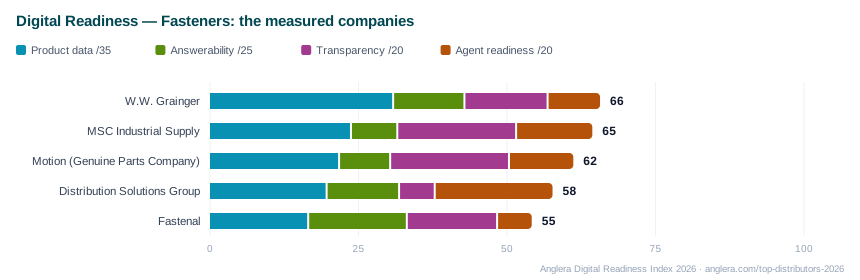
Stacked bars: the four pillars of the Digital Readiness Index — segment lengths are pillar scores, the number is the company's total out of 100.
Rank is this company's position in Anglera's full Top Distributors 2026 index, not a fasteners-only ordering. Only five companies carry a score; the other statuses mean something different for each company, and none of them is a zero, as explained in the DRI methodology.
Why one archetype owns half this category
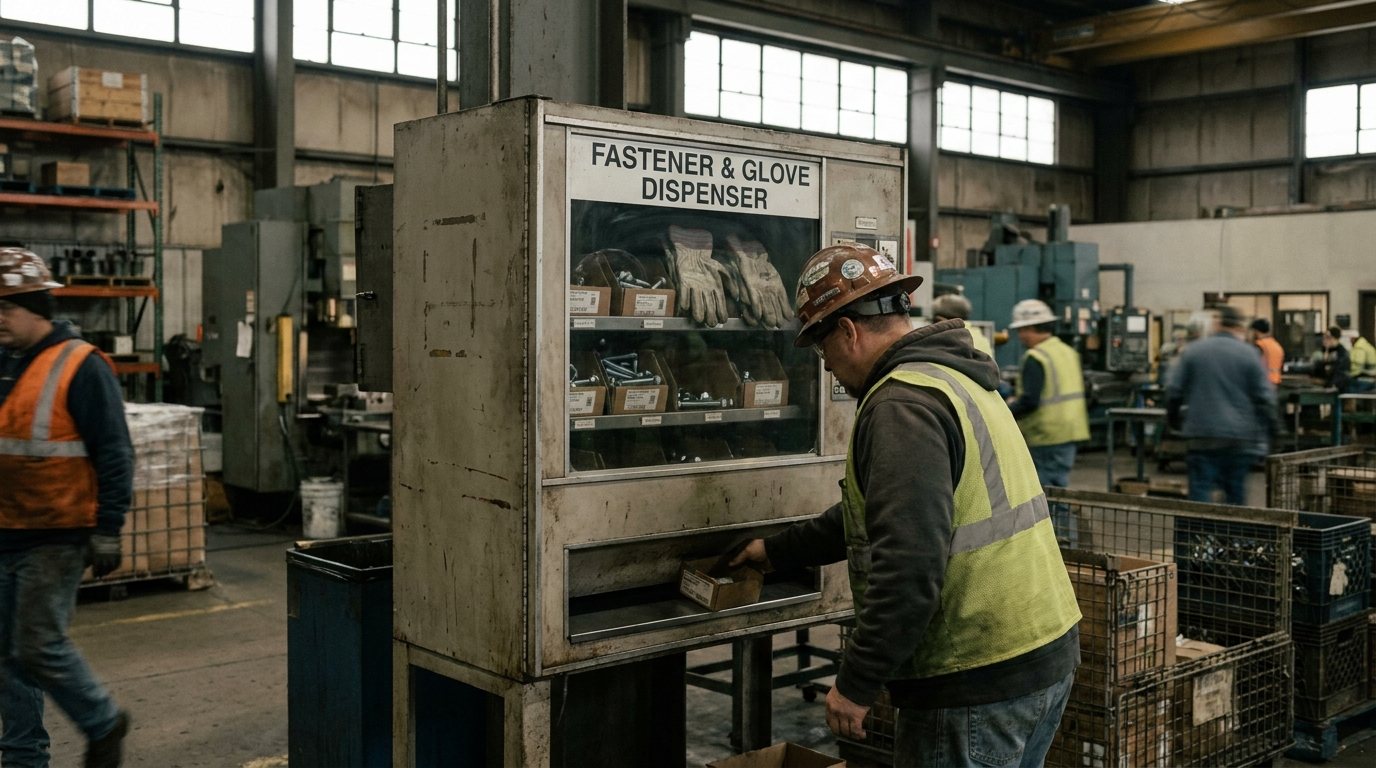
Fasteners is the clearest case in the index of a product category shaping the businesses that sell it. A bolt or a rivet is cheap per unit, consumed constantly, and stops a production line if it runs out at the wrong moment. That combination rewards a rep who restocks a bin at the customer's facility over a website a buyer has to remember to visit, and eleven of the twenty companies here are built around exactly that: vendor-managed inventory, vending machines, and in-plant programs. Kimball Midwest's rationale is the starkest version of it: "almost no customer-facing branches, instead running a very large outside sales force that restocks maintenance bins... directly at customer facilities." Field Fastener names the same idea as its flagship offer, "Data-Driven VMI Programs," ahead of catalog sourcing. Bossard's own annual report calls the company "a leading distributor of fasteners and a provider of related engineering and logistics services" under what it brands a "Proximity" model.
The other archetypes read as exceptions that prove the rule. W.W. Grainger leads on revenue and DRI as a scale-aggregator, but it is less a fasteners specialist than an MRO generalist that happens to carry them, centralizing national-account purchasing from a few large distribution centers rather than running the branch or embedded-rep model most of this list uses. Branch-density shows up in Motion, where roughly 80% of segment revenue still runs through a physical branch network, and in Bisco Industries, whose FY2025 growth is credited to its 51-office sales network rather than SKU count. McMaster-Carr is the vertical's lone catalog-native, and its own archetype rationale calls it "the industry's widely-cited reference standard for digital-shelf product data." Consolidation runs underneath all of it: Distribution Solutions Group is being taken private by majority owner LKCM Headwater at an 81% premium, The Hillman Group has a $315M deal for Kanebridge in flight on top of a Campbell Chain & Fittings acquisition, and Endries International, an MSD Partners-backed platform, just added Blue Chip Engineered Products to its own acquisition cadence.
What five public catalogs actually showed
The program-supplier model explains the small sample directly. The Hillman Group's real catalog, shop.hillmangroup.com, greets visitors with "Register today to begin ordering" and gates every price behind a login, and its pages defeated our standard extractor, which is why its entry reads not observable rather than a score. Würth Industry North America's own site stops at category landing pages, but a verification pass found a live public catalog it does run — Northern Safety, the e-commerce storefront Würth has owned since 2015 — so its entry now reads not yet measured: the catalog is verified live but hasn't been sampled under the index's rules, and no score is published without a sample. Eleven more companies, from Boeing Distribution to Kimball Midwest, sit outside this cut's five-company measurement scope entirely, a scoping fact, not a mark against how any of them runs its business.
That leaves five companies running open, sampleable catalogs, and the range between them (55 to 66, against this vertical's median of 62 and the full index's median of 58) is where the real signal is. MSC Industrial Supply posts the best identifier match rate in the group at 75% GTIN coverage, the number that lets a buyer confirm a fastener page here is the same part as a page anywhere else, alongside a full 20-of-20 on commerce transparency. Motion scores close behind at 62 and ties MSC on transparency, but its consistency spread of 45, the widest here, means the five sampled pages ranged from thin to genuinely deep depending on which category the crawler landed in. That is a more useful number than the median-attribute count of 34 sitting next to it: the gap isn't between Motion and its competitors, it's between Motion's own pages.
Distribution Solutions Group's 58 splits in an unusual way: a perfect 20-of-20 on machine and agent readiness, meaning structured data, sitemap coverage, and crawler access are in order, against a 6-of-20 on commerce transparency, because the operating-company storefront sampled here publishes 0% public pricing. A crawler can read the page; a buyer still can't see a price without logging in. Fastenal, the name most synonymous with this category, scores lowest at 55, with a median attribute count of just 11 and no discoverable sitemap. For a buyer matching a fastener by thread pitch, drive type, head style, grade, or coating, an 11-attribute page is thin, though Fastenal's spread of 6 is the tightest in the group: whatever depth it has, it applies evenly. Only Grainger loses points here, for an explicit AI crawler block; the other four are simply silent on the question, and silence scores full marks under the methodology.
Where this settles
The measurement gap here is unlikely to close on its own. A vertical where 11 of 20 competitors are built around an embedded rep restocking a bin has little commercial reason to publish an open catalog, and the roll-up wave now underway, DSG going private, Endries and EFC still bolting on niche fastener distributors, only concentrates more volume inside that model. The more interesting question for 2026 is whether the buyers who do shop in the open, maintenance techs and OEM engineers cross-referencing a part number, keep drifting toward the five companies willing to show them a page at all.