
Top MRO Industrial Distributors 2026: Scale vs. Digital Shelf
Ferguson and Grainger top MRO distribution's revenue table but land at opposite ends of the Digital Readiness Index across the 25 companies on the MDM MRO list.
Part of Top Distributors 2026 — the Anglera Index: North America’s largest distributors ranked, classified into six operating archetypes, and scored on the measured Digital Readiness Index.
Ferguson and W.W. Grainger are the two largest companies in this vertical by a wide margin, and they land on opposite ends of its digital shelf: Ferguson's typical product page carries zero structured attributes, Grainger's carries 47. Seven of the 25 companies in this MRO/industrial cut of Anglera's Top Distributors 2026 index were measured for public product data, and the group's median score of 58 turns out to be two very differently built catalogs arriving at the same number by two different routes.
The ranking
| Rank | Company | Revenue | Archetype | DRI |
|---|---|---|---|---|
| 10 | Ferguson | $31.3B (CY2025) | scale-aggregator / branch-density | 58 |
| 20 | W.W. Grainger | $17.9B (FY2025) | scale-aggregator | 66 |
| 31 | Motion (Genuine Parts Company) | ~$9.0B (FY2025, segment) | branch-density / scale-aggregator | 62 |
| 35 | Fastenal | $8.2B (FY2025) | program-supplier / branch-density | 55 |
| 57 | Applied Industrial Technologies | $4.56B (FY2025) | technical-specialist / scale-aggregator | not measured (not observable) |
| 65 | MSC Industrial Supply | $3.77B (FY2025) | program-supplier / catalog-native | 65 |
| 70 | DNOW | $2.8B (FY2025) | scale-aggregator / branch-density | not measured (no public catalog) |
| 79 | DXP Enterprises | $2.0B (FY2025) | technical-specialist / program-supplier | 48 |
| 82 | Distribution Solutions Group | $1.98B (FY2025) | pe-rollup / program-supplier | 58 |
| 83 | Vallen Distribution | $1.9B (FY2021, NA, est.) | program-supplier / technical-specialist | not in set |
| 85 | The Hillman Group | $1.55B (FY2025) | program-supplier | not measured (not observable) |
| 86 | Wajax Corp | $1.5B (FY2025) | technical-specialist / branch-density | not yet measured (catalog verified live) |
| 90 | Global Industrial Company | $1.38B (FY2025) | catalog-native | not in set |
| 92 | RS Group (Americas) | ~$1.09B (FY2026, NA) | catalog-native / program-supplier | not in set |
| 106 | Kimball Midwest | $565M (FY2025) | program-supplier | not in set |
| 107 | Descours & Cabaud (North America) | $545M (FY2024, NA) | pe-rollup / branch-density | not in set |
| 109 | R.S. Hughes | $527M (FY2024) | technical-specialist | not in set |
| 114 | Motion & Control Enterprises | $488M (FY2024) | Pe-rollup / technical-specialist | not sampled |
| 115 | BlackHawk Industrial | $460M (FY2020, dated) | pe-rollup / technical-specialist | not in set |
| — | Berkshire Tool Supply Group | not disclosed | catalog-native / program-supplier | not in set |
| — | DGI Supply | not disclosed | technical-specialist | not in set |
| — | McMaster-Carr | not disclosed | catalog-native | not measured (no public catalog) |
| — | Tencarva Machinery | not disclosed | technical-specialist / pe-rollup | not in set |
| — | The Home Depot (Pro) | not disclosed | branch-density / scale-aggregator | not measured (not observable) |
| — | Würth Industry North America | not disclosed | program-supplier / branch-density | not yet measured (catalog verified live) |
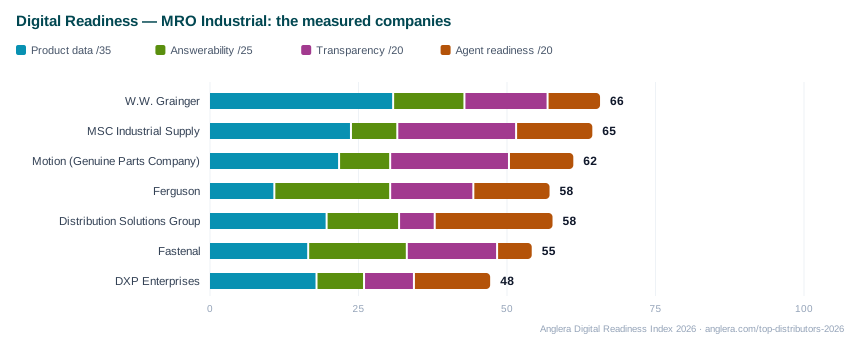
Stacked bars: the four pillars of the Digital Readiness Index — segment lengths are pillar scores, the number is the company's total out of 100.
No single operating model owns this vertical
Split the 25 companies by primary archetype and the channel doesn't consolidate around one playbook. Program-supplier and technical-specialist tie as the largest groups at six apiece; scale-aggregator and branch-density combine for five more; catalog-native and PE-rollup fill out the rest. Fastenal, MSC Industrial, Kimball Midwest, and Würth Industry North America run on embedded people and managed inventory; Applied Industrial Technologies, Wajax, R.S. Hughes, and DGI Supply sell engineering and repair capability layered on parts. Both answer the same problem: MRO buying often needs a person on-site, not just a SKU on a page.
The revenue leaders sit in the scale/branch camp for a reason specific to this category. Ferguson's rationale cites nine tuck-in acquisitions in FY2025 alone, adding roughly $300 million in annualized revenue onto a nationally managed branch network. Grainger's rationale is the mirror image: it centralizes purchasing scale from a small number of large distribution centers rather than chasing branch count, which is why it tops MDM's breadth rankings for this category. Motion, GPC's industrial arm, is mid-transition: a dense branch network is its growth engine even as GPC preps a spinoff targeted to close in Q1 2027.
Consolidation is the loudest signal in this year's moves. DNOW closed a $1.5 billion combination with MRC Global in November 2025, more than doubling its footprint. DXP Enterprises is assembling a national water/wastewater platform acquisition by acquisition. Distribution Solutions Group's largest 2026 event isn't a deal at all: its 79% owner agreed in July to take it private at $35.00 a share, an 81% premium.
What the Digital Readiness Index found
The Digital Readiness Index samples five product pages across five categories of a company's catalog and scores what a machine or buyer can extract, across product data depth, answerability, commerce transparency, and machine/agent readiness. Two companies here landed on an identical overall score of 58 — Ferguson and DSG — and each got there differently.
Ferguson's 58 comes almost entirely from answerability (19.5 of 25) and transparency (14 of 20); its product-data pillar is just 11 of 35, and the median attribute count on a sampled page is zero. DSG's 58 is the opposite shape: a perfect 20 of 20 on machine and agent readiness against a transparency score of just 6, because pricing wasn't publicly visible on any sampled page.
Grainger's 66 is the vertical's high score, and it's a product-data story: 31 of 35 on that pillar and a median of 47 structured attributes per page, more than four times Ferguson's zero and roughly double MSC's 25. For a buyer cross-matching a bearing, valve, or fastener against a spec sheet, that gap is the difference between a page that answers "will this fit" and one that doesn't. Grainger is also the only measured company here with an explicit AI-crawler block; every other measured distributor left the question unaddressed, which this methodology scores as full marks, not a penalty. MSC and Motion both posted perfect transparency scores. Fastenal's 55 carries the weakest machine-readiness pillar (6 of 20) and the only broken sitemap measured. DXP's 48 is the low score, held back by a transparency pillar of 8.4; price was public on only 40% of its sampled categories, gated on the rest.
Three different reasons kept the rest of this cut unscored. Applied Industrial was not observable — bot protection stopped measurement even though applied.com is known to run millions of SKUs publicly. DNOW has no public catalog: its storefront sits behind a full account login before any browsing. Wajax and Würth were on that list until an August verification pass found live public product pages both companies operate — full-spec equipment pages on wajax.com, and complete e-commerce at Würth-owned Northern Safety — so each now reads not yet measured (catalog verified live), queued for the next run rather than scored off an unsampled catalog. McMaster-Carr still carries a no-public-catalog status, notable since the site is widely cited as the category's reference standard for published specs on its family pages — a reminder this label describes the sample, not a verdict on the catalog. Hillman and Home Depot Pro were not observable, a tooling limit, not a statement about either site.
Where this vertical is heading
Every recent move points the same direction: MRO distribution is still consolidating, fast. DNOW just doubled through MRC Global, GPC is preparing to spin Motion out as a standalone public company, and Descours & Cabaud closed ten deals in 2024 with a further five-acquisition wave in 2025, keeping acquired brands under their own names. What the Digital Readiness Index adds is a second axis revenue rank won't show: several of the largest, most acquisitive names here are also running product pages a crawler or buyer can barely parse. Scale and digital shelf quality are on separate timelines, and nothing here suggests the two are converging yet.