
Gases & Welding Supplies 2026: Branch Density Wins, Digital Lags
Eighteen gas and welding distributors ranked and scored. F.W. Webb outscores Fastenal and Airgas on digital readiness despite a fraction of their revenue.
Part of Top Distributors 2026 — the Anglera Index: North America’s largest distributors ranked, classified into six operating archetypes, and scored on the measured Digital Readiness Index.
Eighteen distributors make this vertical's cut, but only five had public catalogs we could measure, and the results scramble the revenue ladder. F.W. Webb, a $2.6 billion Northeast branch operator, posts the highest Digital Readiness Index score of the group at 65, ahead of both Fastenal at $8.2 billion (DRI 55) and Airgas, an Air Liquide company, at $7.5 billion (DRI 46). Company size and digital shelf performance are two different lists in this vertical, and the gap between them is the story.
The 2026 Ranking
Ranks below reflect each company's position in Anglera's full Top Distributors 2026 index, which spans every vertical; the eighteen companies here are the ones the index groups into Gases & Welding Supplies. Digital Readiness Index (DRI) scores, explained in full in our methodology, run 0-100 across four measured pillars.
| Rank | Company | Revenue | Archetype | DRI |
|---|---|---|---|---|
| 21 | Linde (Americas) | $15.2B (FY2025, segment) | Scale-aggregator / program-supplier | not measured |
| 35 | Fastenal | $8.2B (FY2025) | Program-supplier / branch-density | 55 |
| 40 | Airgas, an Air Liquide company | $7.5B (FY2024, NA, est.) | Scale-aggregator / branch-density | 46 |
| 72 | F.W. Webb | $2.6B (FY2025) | Branch-density | 65 |
| 74 | Matheson | $2.44B (approx.) (FY2025, NA, est.) | Technical-specialist / scale-aggregator | not measured |
| 75 | AmeriGas Propane | $2.28B (FY2025, segment) | Scale-aggregator / branch-density | not measured (no public catalog) |
| 112 | Arc3 Gases | $500M+ (FY2025, est.) | Branch-density | 43 |
| 119 | nexAir | $400M (FY2022, dated) (FY2022, dated) | Branch-density / scale-aggregator | not measured |
| 130 | Roberts Oxygen Company | ~$220M (est.) (CY2025, est.) | Branch-density / technical-specialist | not measured |
| 134 | Indiana Oxygen | ~$100M (FY2023, est.) | Technical-specialist / branch-density | not measured |
| 137 | Charbone Corporation | $0.2M (FY2025) | Technical-specialist / program-supplier | not sampled |
| — | American Welding & Gas | not disclosed | Branch-density | 42 |
| — | Gas And Supply Co. | not disclosed | Branch-density | not measured |
| — | General Air | not disclosed | Branch-density | not measured |
| — | Meritus Gas Partners | not disclosed | PE-rollup / branch-density | not measured |
| — | Norco Inc. | not disclosed | Branch-density / technical-specialist | not measured |
| — | O.E. Meyer | not disclosed | Branch-density / technical-specialist | not measured |
| — | Red Ball Oxygen Co. | not disclosed | Branch-density / technical-specialist | not measured |
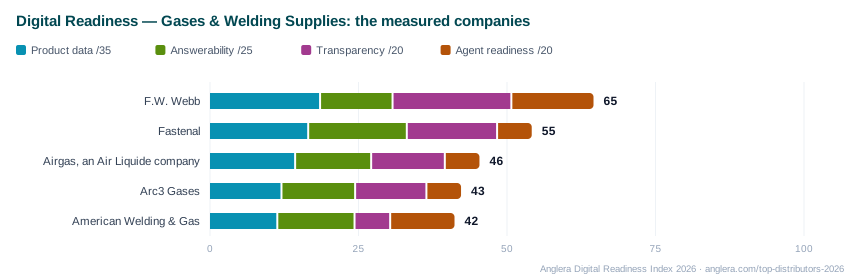
Stacked bars: the four pillars of the Digital Readiness Index — segment lengths are pillar scores, the number is the company's total out of 100.
A Vertical Built on Trucks and Counters
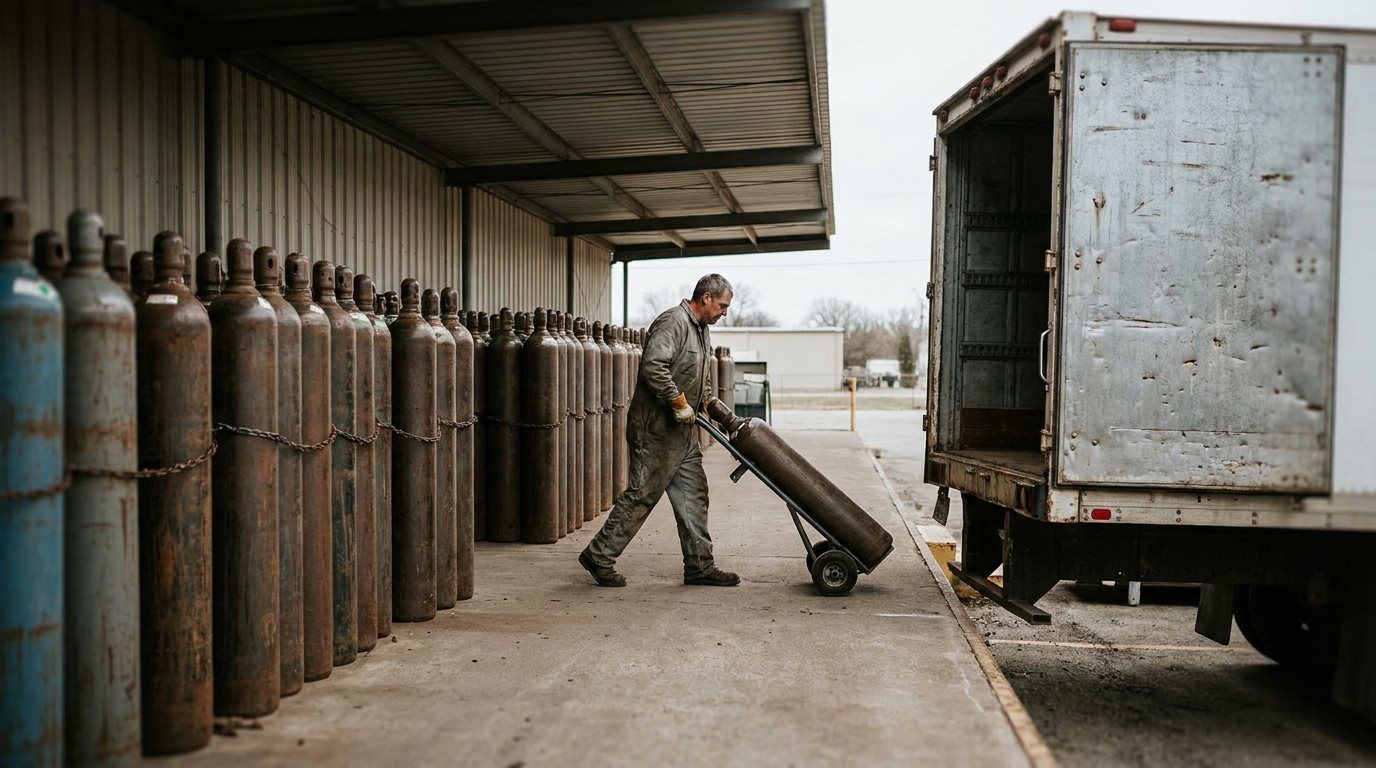
Ten of the eighteen companies here carry branch-density as their primary archetype, and it is a physical necessity more than a strategic choice. Gas cylinders are heavy and hazardous to move long distances and need local fill or exchange infrastructure; welding supply purchases run through will-call counters and technical service relationships as often as through a cart. Roberts Oxygen, General Air, O.E. Meyer, Red Ball Oxygen and several others built regional footprints almost entirely through organic branch openings, and each pairs that footprint with a technical-specialist secondary label: calibration labs, EPA protocol gas production, welder repair.
The exception is Meritus Gas Partners, the vertical's one pe-rollup, sponsored by AEA Investors on a stated platform strategy with eight deals since 2021. It has not slowed: a July 31 acquisition of five-location Dallas-Fort Worth distributor Metroplex Welding Supply followed a March 2026 purchase of Greens Welding Supply in Granbury, Texas, and a July 2026 deal for HICO Distributing of Colorado. Each acquired shop keeps trading under its own local brand, an admission that branch-density's local identity is worth preserving even inside a roll-up. Arc3 Gases runs a quieter version of the same playbook, growing to 60 locations by folding in small operators like Economy Welding & Industrial Supply and Hall's Welding Supplies rather than centralizing into a few large distribution centers.
At the top of the size scale, the model looks different only because the companies are bigger. Linde's distribution runs on what the company itself calls networks of "thousands of production plants, pipeline complexes... and delivery vehicles," and Airgas layers nearly 800 branches, retail stores and fill plants onto Air Liquide's production scale. AmeriGas took branch-density furthest into a pure service model: no catalog exists to browse, only a delivery quote request and a MyAmeriGas login, consistent with an archetype built by rolling up local propane distributors into one centrally purchased, locally delivered brand.
What the Product Pages Actually Show
Only five of the eighteen companies had a public, unauthenticated catalog our extractor could sample, and the spread among them is wide. This vertical's median DRI of 46 sits well below the 58 median across Anglera's full index, and the pillar breakdown explains why.
F.W. Webb's 65 comes from a near-perfect commerce transparency score (20 of 20) and the only confirmed product structured data in the group, which lifts its agent-readiness pillar to 14 of 20 against 6 for three of its four peers. But its consistency spread of 21 points is the widest we measured in this cut: a median of 16 attributes per page masks category pages that are richly built out sitting next to ones that are not. F.W. Webb is also the one company here whose robots.txt explicitly blocks AI crawlers, a policy choice that costs it points the other four keep by simple silence, since an absent rule permits a crawler rather than penalizing the company for one.
Fastenal is the most evenly built of the five, scoring within a few points of its own average across product data (16.7), answerability (16.6) and transparency (15.2), with a median of 11 attributes per page and the sample's best, if still modest, 20 percent GTIN match rate. Airgas trails on product data (14.5) with a median of just 4 attributes per page; our sampler noted its category navigation runs several levels deep, for example Safety Products to Gloves to Coated Work Gloves, before reaching an actual product grid. Arc3 Gases and American Welding & Gas both hide pricing behind a "Call for price" pattern, dragging their transparency pillars to 12 and 6, the lowest score in any pillar for any measured company here. Arc3's consistency spread of 2 is the tightest we measured anywhere: it treats every sampled page almost identically, just identically thin.
For a buyer of gases and welding consumables, the attributes that actually matter are specific: cylinder size and CGA valve fitting, gas purity or mixture composition, pressure rating, welding process compatibility (MIG, TIG, stick, flux-core), filler wire diameter and AWS classification, and whether a cylinder is sold, leased or exchanged. A median of 3 to 6 attributes, where Arc3 and American Welding & Gas both sit, rarely clears that bar. A median of 16, where F.W. Webb sits, gets closer, provided the buyer happens to land on one of the well-built pages rather than one of the thin ones.
Where This Leaves the Vertical
The physical logic of gas and welding distribution, trucks, fill plants, will-call counters, is not going away, and it will keep branch-density as the default model whether the operator is an independent adding its ninth location or a PE platform stitching together its ninth acquisition. What is still unsettled is whether any of the measured operators close the gap between physical service quality, which by every account here is strong, and the kind of consistent, structured product data that lets a buyer or an AI shopping agent confirm fit without picking up the phone. Right now the honest answer, across five very different companies, is not yet, unevenly.