
Top Plumbing Distributors 2026: Size Doesn't Predict the Shelf
Six leading plumbing distributors ranked and scored on the Digital Readiness Index — where a $2.6B family business out-digitizes a $31.3B public giant.
Part of Top Distributors 2026 — the Anglera Index: North America’s largest distributors ranked, classified into six operating archetypes, and scored on the measured Digital Readiness Index.
Plumbing distribution's six largest players split almost evenly by operating model, but not by digital performance: the smallest revenue company we measured in this vertical, F.W. Webb at $2.6B, posted a Digital Readiness Index score one point off the vertical's top and seven points ahead of the group leader by revenue. Size and shelf quality are not the same axis here, and the gap between them is the story.
The 2026 Plumbing Distributor Ranking
| Rank | Company | Revenue | Fiscal Year | Archetype | DRI |
|---|---|---|---|---|---|
| 10 | Ferguson | $31.3B | CY2025 | Scale-aggregator / branch-density | 58 |
| 20 | W.W. Grainger | $17.9B | FY2025 | Scale-aggregator | 66 |
| 32 | Winsupply | $8.4B | FY2026 | Branch-density | not measured (no public catalog) |
| 59 | Hajoca | $4.2B | FY2025 | Branch-density | not yet measured (catalog verified live) |
| 67 | Reece USA | $3.3B (NA) | FY2025 | Branch-density | 51 |
| 72 | F.W. Webb | $2.6B | FY2025 | Branch-density | 65 |
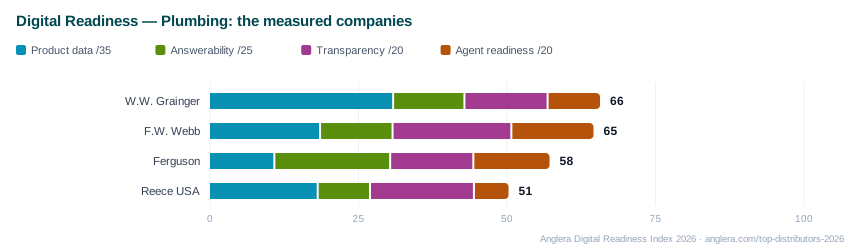
Stacked bars: the four pillars of the Digital Readiness Index — segment lengths are pillar scores, the number is the company's total out of 100.
Ranks are positions in Anglera's full Top Distributors 2026 list, where Ferguson and Grainger place among the largest distributors in North America across any category and F.W. Webb and Hajoca compete on regional depth rather than national scale. Digital Readiness Index scores and methodology are explained in full at /top-distributors-2026/methodology.
A vertical built on local ownership, with two exceptions
Four of the six companies here run on the same operating logic: branch-density, meaning growth and competitive advantage come from a dense local footprint rather than centralized scale. Winsupply's rationale describes 680+ hyper-local "Local Companies" with real equity and P&L held by branch presidents. Hajoca runs 450+ "Profit Centers" under more than 60 retained regional trade names, each manager controlling local inventory, pricing, and hiring. Reece USA grew its US network to 267 branches in FY25 through six bolt-on acquisitions plus organic openings. F.W. Webb has built regional dominance across the Northeast through more than 100 locations, explicitly framing continued greenfield openings as a contrast to PE-backed roll-ups.
Ferguson and Grainger sit apart. Ferguson is classified as scale-aggregator with branch-density as a secondary trait: it layers a steady cadence of tuck-in acquisitions (nine in FY2025 alone, adding roughly $300M in annualized revenue through deals like HPS Specialties and Water Resources Inc.) onto an already-large, centrally managed distribution network. Grainger is a pure scale-aggregator, centralizing national-account coverage and purchasing scale from a small number of large distribution centers rather than competing on branch count. That split explains the revenue gap at the top of the table: the two companies built for national purchasing scale and acquisitive growth are also the two largest by revenue, while the branch-density operators cluster lower on the size axis even as several of them, per their own 2025-2026 moves, keep adding branches. Hajoca's acquisition of American Refrigeration Supplies, a 34-branch, two-DC HVAC/refrigeration distributor closing January 30, 2026, pushed its North American location count past 450 and marks its first entry into the Southwest — branch-density growth executed through M&A rather than greenfield openings, a variant on the model worth watching.
Two of the four branch-density companies, Winsupply and Hajoca, carry no score, and both for reasons rooted in how far they push local autonomy. Winsupply has no public catalog to sample: its local-company sites are brochureware. Hajoca's corporate site is brochureware too, but a verification pass found live per-branch storefronts under its regional trade names — public product pages with pricing and branch stock — so its entry reads not yet measured: the catalog is verified live but hasn't been sampled under the index's rules, and no score is published without a sample. Reece USA and F.W. Webb, also branch-density by classification, both run centralized e-commerce storefronts our probe could measure — proof that branch-density as an ownership structure doesn't force a company away from a unified digital catalog. It's a choice, and here the two oldest, most locally federated operators made the opposite one.
What the measured pages actually showed
The vertical's median DRI is 61.5, ahead of 58 for the full index, and driven almost entirely by two companies bunched at the top: Grainger at 66 and F.W. Webb at 65, one point apart despite a revenue gap of roughly $15.3 billion. Ferguson sits at 58 and Reece USA at 51.
The pillar breakdown is where this gets specific. Grainger's 66 rests on the strongest product data depth score in the group, 31 of 35, with a median of 47 structured attributes per sampled page — comfortably the richest catalog measured in this vertical. For a buyer trying to cross-reference a specific fitting by pipe diameter, thread type, material, and pressure rating, 47 attributes is enough room to actually filter on those specs rather than guess from a title. But Grainger's answerability pillar is comparatively weak at 12 of 25, and its agent-readiness score, 9 of 20, is dragged down by an explicit block on AI crawlers.
Ferguson is the inverse case, and the more surprising one given its size. Its answerability pillar scores 19.5 of 25, the strongest in the vertical — descriptive content, imagery, and catalog consistency are solid. But its product data pillar is just 11 of 35, with a median attribute count of 0 across the sampled pages. For the largest plumbing distributor in the country by a wide margin, that means the sampled product pages read well to a human buyer but hand a machine or shopping agent almost nothing to match a SKU against. Pricing and stock were visible without login on bathroom faucets and residential water heaters but gated on other sampled categories, per our probe notes.
Reece USA scores lowest at 51, but not uniformly. Its transparency pillar is the best in the group, 17.5 of 20 — real branch-based pricing and stock visible while browsing as a guest, no account required. It also posts the only meaningful GTIN match rate among the four measured companies, 75%, which matters more than any other single number here: a GTIN is the identifier that lets a buyer or a marketplace confirm two listings are the same physical product. Where Reece falls down is answerability, 8.8 of 25, and agent readiness, 6 of 20 — the lowest of either pillar in the vertical, with no sitemap coverage found for product URLs.
F.W. Webb's 65 is the most balanced showing: a perfect transparency score, 20 of 20, and the vertical's highest agent-readiness score, 14 of 20, built substantially on being the only company in this group with confirmed product structured data (JSON-LD) on its pages — even though F.W. Webb, like Grainger, explicitly blocks AI crawlers. That pairing is worth sitting with: a company can lock the front door to AI agents while still leaving well-marked product data behind it, and on this measure, machine-readable markup counted for more than the robots.txt stance. F.W. Webb's median attribute count, 16, sits between Reece's 9 and Grainger's 47, but its consistency spread, 21 points between richest and thinnest sampled page, is the widest gap of the four — a sign that quality depends heavily on which category a buyer happens to land in.
Where this settles
Plumbing distribution's 2025-2026 moves are almost all about branch footprint: Ferguson's tuck-ins, Winsupply's 20 planned Local Company openings, Reece's completed rebrand under one banner, F.W. Webb's Somerdale, NJ location, Hajoca's push into the Southwest via the ARS deal. None of it is aimed at the digital catalog directly, and the DRI results show it: even the vertical's best score, Grainger's 66, leaves real room on answerability and agent readiness, and the two companies built most tightly around local branch autonomy don't have a central catalog to score at all. The distributors here compete on where their trucks and counters are. The next round of separation may come from whether that local density gets attached to a catalog a machine can actually read.