
Top Power Transmission & Bearings Distributors 2026
Ranking and Digital Readiness scoring for the ten largest Power Transmission & Bearings distributors, from Grainger to family-owned specialists like BDI and Purvis.

Part of Top Distributors 2026 — the Anglera Index: North America’s largest distributors ranked, classified into six operating archetypes, and scored on the measured Digital Readiness Index.
Genuine Parts Company told investors in February 2026 that Motion, its industrial distribution arm, will split from NAPA into its own publicly traded company, a tax-free separation targeted to close in the first quarter of 2027. That single fact reframes most of this year in Power Transmission & Bearings: the vertical's second-largest company by revenue is about to trade on its own digital-shelf performance, without an automotive-retail business to average against. Ten companies make up this cut of the Top Distributors 2026 index; only four carry a measured Digital Readiness score this edition.
The ranking
| Company | Archetype | Revenue | Fiscal Year | Overall Rank | DRI Score |
|---|---|---|---|---|---|
| W.W. Grainger | Scale-Aggregator | $17.9B | FY2025 | 20 | 66 |
| Motion (Genuine Parts Company) | Branch-Density / Scale-Aggregator | ~$9.0B (segment) | FY2025 | 31 | 62 |
| Applied Industrial Technologies | Technical-Specialist / Scale-Aggregator | $4.56B | FY2025 | 57 | — |
| DXP Enterprises | Technical-Specialist / Program-Supplier | $2.0B | FY2025 | 79 | 48 |
| Wajax Corp | Technical-Specialist / Branch-Density | $1.5B | FY2025 | 86 | — |
| Bearing Distributors Inc. (BDI) | Branch-Density | $1.0B | FY2024 | 94 | 58 |
| IBT Industrial Solutions | Technical-Specialist | $135M (est.) | FY2022 | 133 | — |
| Bearing Headquarters Company (HeadCo) | Technical-Specialist | not disclosed | — | Not ranked | — |
| OTC Industrial Technologies | PE-Rollup / Technical-Specialist | not disclosed | — | Not ranked | — |
| Purvis Industries | Branch-Density | not disclosed | — | Not ranked | — |
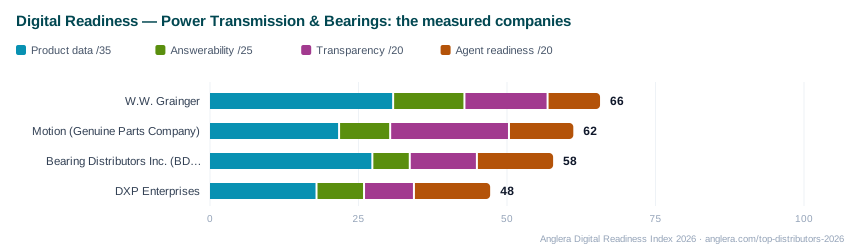
Stacked bars: the four pillars of the Digital Readiness Index — segment lengths are pillar scores, the number is the company's total out of 100.
A vertical built on repair, not just SKUs
Half of the ten companies here are classified primary technical-specialist: Applied, DXP, Wajax, HeadCo, and IBT. That is not a coincidence of who happened to be in the data set — bearings and power transmission is one of the few distribution categories where the repair shop is as much the business as the shelf. HeadCo runs five in-house metalworking shops and Timken-certified gearbox and bearing rebuild operations. Wajax reports Product Support and Engineered Repair Services as its own roughly $385M FY2025 line, layered on 125 Canadian branches. DXP's Innovative Pumping Solutions segment engineers and fabricates pump packages rather than just stocking parts. IBT closed its acquisition of Indesco, a Charlotte hydraulics and power-transmission distributor, in June 2026 specifically to extend its gearbox-rebuild and specialty-machining footprint into the Southeast. Applied spent FY2025's $293.4M M&A budget on Hydradyne and IRIS Factory Automation, both application-engineering plays, then announced Thompson Industrial Supply in January 2026.
The other half splits between branch-density and one straightforward roll-up. Motion runs roughly 80% of its segment revenue through a dense North American branch network built for local parts availability — the model it is about to defend as a standalone public company. BDI got to 200-plus locations through organic branch openings, including a first Oklahoma site and expanded Atlanta and Charlotte facilities through 2025, and its own account of that strategy explicitly contrasts it with rivals' "headline-grabbing mega-acquisitions." Purvis operates over 100 branches across 18 states and just added two more through the 2025 acquisitions of A&A Resources and Johnson Bearing & Supply. OTC is the vertical's clearest financial-sponsor story: Genstar Capital has taken it through 23-plus bolt-ons, most recently Fleetwood Industrial Products, P-M Industrial, Premier Equipment Corporation, and Premier Control Systems in 2025.
Grainger is the outlier by design. It centralizes national-account coverage and purchasing scale from a small number of large distribution centers rather than a dense branch count, which is why it tops MDM's broader Industrial Supply and MRO rankings — but power transmission and bearings is one slice of a much wider catalog for a company that just exited the UK market entirely, closing Zoro UK and selling Cromwell to AURELIUS at a roughly $196M loss on exit.
What the Digital Readiness Index found
The Digital Readiness Index scores four measured companies here, and the spread tells a sharper story than the rankings alone. Grainger leads at 66, built on the vertical's strongest product-data pillar (31 of 35) — the deepest identity, identifiers, and attribute data of the group. But its machine and agent readiness pillar is the group's weakest at 9 of 20, because Grainger's robots.txt explicitly blocks AI crawlers. That is a real deduction, not an oversight: Motion, DXP, and BDI all left AI crawler access unaddressed, which under this methodology reads as silence and scores full marks, while Grainger's explicit block costs it points the other three keep.
Motion comes second at 62, anchored by a perfect commerce-transparency score of 20 out of 20 — every sampled product carried open pricing and stock visibility with no login gate, confirmed across all five URLs pulled from the now fully rebranded motion.com storefront. What holds Motion back is consistency: a median of 34 attributes sounds respectable, but the 45-point gap between its richest and thinnest sampled page is the largest in this cut. A buyer hitting the wrong category gets a page that reads nothing like the one two clicks away, which is a harder problem to fix than a low average and the one Motion inherits into its 2027 spin-off.
BDI sits at 58, the only measured company with a 100% GTIN match rate on sampled products — a direct reflection of the same organic, branch-by-branch discipline that shapes its growth strategy. DXP is lowest among the measured at 48, with a median of just 11 attributes per page, roughly a quarter of Grainger's depth, and public pricing on only 40% of sampled products. Its real storefront lives at store.dxpe.com; the corporate site at dxpe.com is brochureware whose category links dead-end in contact forms.
For a buyer in this category, the attribute list that matters is specific: bore diameter, outer diameter and width, load and RPM rating, seal or shield type, lubrication spec, shaft size for couplings, belt pitch or type, and a manufacturer part number or GTIN clean enough to cross-reference against a competitor's SKU. An 11-attribute median page rarely carries more than three or four of those, pushing the buyer back to a phone call or a spec-sheet PDF exactly where a faceted search or shopping agent should have closed the loop. Grainger's 47-attribute median has room for most of them.
The rest of the vertical didn't produce a score, for reasons worth keeping separate. Applied's catalog is real and large, with a bearings category at applied.com carrying millions of SKUs reachable without login, but bot protection stopped the measurement itself, so "not verifiable" describes our tooling, not Applied's site. Wajax and OTC sit in a different bucket: a later verification pass found live public product pages for both, so their status is now "not yet measured (catalog verified live)" — scores are only published from rule-compliant samples, and neither had one this edition. HeadCo, IBT, and Purvis weren't in the measured set, and none of the three publish revenue.
Where this settles
Ownership structure doesn't predict digital investment here — a public company (Grainger) leads, a soon-to-be-independent subsidiary (Motion) is close behind, a family-owned branch network (BDI) is a clear third, and another public company (DXP) trails the measured group. The real divide is between the two operating models: technical-specialist companies built around repair and engineering capability are either unmeasured — blocked by bot protection or awaiting a first catalog sample — or scored at the bottom of those that could be measured, while the branch-density and scale generalists sit at the top of the readiness table. Motion is the name to watch through 2027 — once it reports as an independent public company, a 45-point consistency spread stops being a rounding error inside a diversified parts conglomerate and becomes a metric investors can ask about directly.