
Top Electronics Distributors 2026: Depth Loses to Access
Electronics distribution ranked by revenue, archetype, and a measured Digital Readiness Index — where deep catalogs and thin ones score closer than expected.

Part of Top Distributors 2026 — the Anglera Index: North America’s largest distributors ranked, classified into six operating archetypes, and scored on the measured Digital Readiness Index.
Component distribution is an eight-company field this cut, and five of them now carry measured Digital Readiness Index scores. The most useful data point in this vertical: the company with eleven times the median product attributes did not win the Digital Readiness Index. It lost, by seven points, to a distributor whose product pages carry almost nothing at all.
The ranking
| Rank | Company | Revenue (fiscal year) | Archetype | DRI Score | DRI Status |
|---|---|---|---|---|---|
| 11 | Arrow Electronics | $30.9B | Scale-aggregator | 49 | Measured |
| 17 | Avnet | $22.2B | Scale-aggregator / catalog-native | 57 | Measured |
| 42 | D&H Distributing | ~$7.0B | Catalog-native / program-supplier | — | Not scored — not sampled |
| 52 | Future Electronics | $5.17B (est.) | Technical-specialist / scale-aggregator | 68 | Measured |
| 61 | Mouser Electronics | $4.1B (dated) | Catalog-native | — | Not in measurement set |
| 63 | DigiKey | $3.96B (est.) | Catalog-native | 53 | Measured |
| 64 | TTI Inc. | $3.78B (dated) | Scale-aggregator / program-supplier | — | Not in measurement set |
| 120 | WPG Americas | ~$390M (NA, est.) | Scale-aggregator / technical-specialist | 60 | Measured |
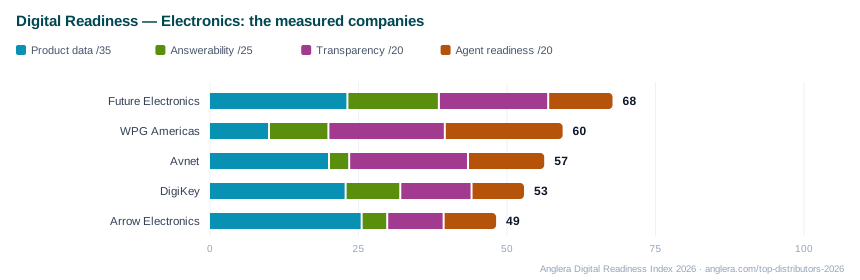
Stacked bars: the four pillars of the Digital Readiness Index — segment lengths are pillar scores, the number is the company's total out of 100.
Full index and methodology at /top-distributors-2026; the scoring methodology explains how the four-pillar, 100-point Digital Readiness Index is built from five sampled product pages per site.
Scale runs this vertical, for a structural reason
Four of the eight companies here carry scale-aggregator as their primary archetype, and a fifth, Future Electronics, lists it as secondary. That concentration makes sense once you look at how the business actually works. Component distribution isn't won by owning the closest branch to a buyer, it's won by owning the widest supplier line card and the deepest inventory buffer, so a customer can source thousands of disparate parts through one relationship instead of hundreds. Arrow Electronics runs the model at global scale: over 140 sales facilities but only 39 distribution and value-added centers across more than 85 countries, per its archetype rationale, concentrating fulfillment in a small number of large hubs rather than spreading it thin. TTI Inc. runs the same logic domestically, with 13 major distribution centers and over 3 million square feet of warehouse space standing in for a branch network, feeding its "available-to-sell inventory" promise to production-volume aerospace and defense manufacturers.
DigiKey and Mouser Electronics — two of the cut's three catalog-native distributors, alongside newly added D&H Distributing — compete on a different axis entirely: the low-quantity prototype order that scale-driven distributors are structurally bad at filling profitably. DigiKey ships same-day from a published in-stock catalog of more than 17.5 million components across nearly 3,000 manufacturers, with no salesperson required to place an order. WPG Americas sits in an odd third position: a subsidiary of WPG Holdings, Asia's largest electronics distributor and franchise partner to nearly 250 suppliers, it inherits scale-aggregator economics from its parent's centralized purchasing rather than building local branch density of its own, with a technical-specialist streak layered on top.
The two largest companies by revenue in this vertical, Arrow ($30.9B) and Avnet ($22.2B), both block standard clients, so their catalogs were measured through a full browser session, disclosed on their scorecards: Arrow scored 49, Avnet 57. Future Electronics, re-measured with the standard pipeline after a transient failure in the first run, posted a 68, the vertical's top score, on an FY2023 revenue figure that predates its full absorption into WT Microelectronics, which credited "Future's recovery" for helping push its own consolidated FY2025 results to record highs.
What the index actually found
The sharpest contrast among the five measured companies is DigiKey against WPG Americas, and the pillar breakdown is where it gets interesting. DigiKey wins product data depth comfortably, 23 of 35 points against WPG's 10.1, and its median attribute count of 34 per sampled page is what you'd expect from a company whose entire pitch is parametric search across millions of components. WPG's median is 3. Three attributes is barely enough to tell one product from another, let alone let a buyer filter by package type, tolerance, voltage rating, or mounting style, which is the kind of screening any real component search has to support. The gap tracks the underlying catalogs: DigiKey's stated 17.5 million SKUs against the roughly 3,394 SKUs on WPG Americas' public storefront, a much smaller and more general-purpose site.
Yet WPG still finishes ahead on the overall score, 60 to 53, because the other two pillars invert the picture. WPG scored 19.6 of 20 on commerce transparency against DigiKey's 12, with a 100 percent price-visibility rate on its sampled pages versus 0 percent for DigiKey. And WPG posted a clean 20 of 20 on machine and agent readiness, with confirmed product structured data and a working sitemap, against DigiKey's 9 of 20, where the sitemap check failed. Worth noting on that pillar: WPG's AI-crawler stance reads as "unaddressed" in our data, and under this index's scoring that means no explicit block was found, which scores full marks rather than a penalty. DigiKey's stance reads as "partial." Neither company's product pages were flagged for containing a GTIN in either sample. DigiKey's consistency spread of 29 points, against WPG's spread of just 2, tells the more granular story: DigiKey's pages vary widely in how much a given manufacturer's listing gets filled out, a plausible byproduct of aggregating data from nearly 3,000 different suppliers, while WPG's five sampled pages were treated almost identically to one another, for better and worse.
The practical read for a buyer: DigiKey's catalog will actually answer "what part is this and will it fit," but a buyer has to work harder to see the price and stock status without contacting someone. WPG's storefront tells you the price instantly and a crawler can index it cleanly, but the page itself won't tell a design engineer much about the part.
Where this settles
The measured companies are demonstrating variations on the same unfinished job: rich product data and open commerce data haven't fully landed on the same page at any of them. The vertical's biggest revenue holders now have scores, and neither leads: Arrow's 49 is the lowest measured score in the cut and Avnet's 57 sits mid-pack, which is itself worth tracking as Arrow works through its Dell ECS wind-down and leadership transition alongside Avnet's new Chief Digital Officer mandate. If digital readiness in electronics distribution converges toward WPG's transparency-and-structure profile without losing DigiKey's attribute depth, that's the version of this catalog an AI shopping agent could actually shop from without a phone call.