
The Technical Specialists: How 36 Distributors Win
36 distributors that sell engineering, not SKUs. Most are private and unranked, and the four we measured split around the index median for a structural reason.

Part of Top Distributors 2026 — the Anglera Index: North America’s largest distributors ranked, classified into six operating archetypes, and scored on the measured Digital Readiness Index.
At DH Sutherland, a buyer does not check out. Every product page for its aerospace adhesives and composites, filterable by manufacturer and type, browsable without a login, ends the same way: a button that reads "Contact." No price. No cart. That is not a broken storefront. It is the entire technical-specialist model rendered as a single UI decision — the catalog exists to inform the conversation, not to replace it.
The roster
Thirty-six distributors run this model in our data set. Only eighteen disclose enough revenue to be ranked, and just four have measured Digital Readiness Index scores; the other eighteen are private, unranked, and in most cases never entered the batch of catalogs we sampled at all. That imbalance is itself the finding, and we return to it below.
| Company | Rank | Revenue | Ownership | DRI |
|---|---|---|---|---|
| Applied Industrial Technologies | 57 | $4.56B (FY2025) | Public | not measured (not observable) |
| Future Electronics | 52 | $5.17B (FY2023, est.) | Subsidiary | 68 |
| Matheson | 74 | $2.44B (approx.) (FY2025, NA, est.) | Subsidiary | not in set |
| DXP Enterprises | 79 | $2.0B (FY2025) | Public | 48 |
| Wajax Corp | 86 | $1.5B (FY2025) | Public | not yet measured (catalog verified live) |
| Gresco Utility Supply | 99 | $846M (FY2025) | Private/family | not in set |
| R.S. Hughes | 109 | $527M (FY2024) | Private/family | not in set |
| Bridgestone HosePower | 125 | $287M (FY2024, segment, est.) | Subsidiary | not measured (no public catalog) |
| Motion & Flow Control Products | 128 | ~$272M (FY2025, est.) | Private/family | not in set |
| DH Sutherland | 136 | ~$8M (est.) (recent (estimate), est.) | Private/family | 47 |
| EIS Inc. | — | not disclosed | Private/PE | 60 |
| Associated Industries | — | not disclosed | Private/family | not measured (not observable) |
| 22 more companies | not ranked | not disclosed | mostly private/family or ESOP | not in set |
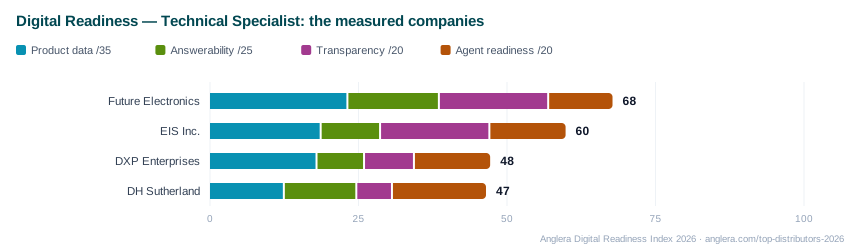
Stacked bars: the four pillars of the Digital Readiness Index — segment lengths are pillar scores, the number is the company's total out of 100.
Full roster of all 36, including the long tail not shown above, is in the complete Top Distributors 2026 index.
How the model actually works
The tell that unifies this group is not a product category, it is a cost structure. Applied Industrial Technologies spent $293.4 million on M&A in FY2025, and the acquisitions were not catalog additions — IRIS Factory Automation and the pending Thompson Industrial Supply deal both add application-engineering and repair capability, on top of the Hydradyne fluid-power business it folded in during 2024. DXP Enterprises reports its Innovative Pumping Solutions segment separately at $390.3 million, up 26.4% year over year, because that revenue is engineered and fabricated pump packages, not resale. Tencarva Machinery runs 22 full-service repair shops staffed by more than 100 engineers across 35 locations and, backed by PE sponsor Bessemer Investors, closed three bolt-on fluid-handling acquisitions in fourteen months.
The pattern repeats: HeadCo runs five in-house metalworking shops doing Timken-certified gearbox rebuilds. Levitt-Safety owns NL Technologies, a NIOSH-approved respirator manufacturer, rather than only reselling third-party PPE. IEWC built a new Controls business unit out of two 2025-2026 acquisitions, pairing wire distribution with its own control-panel manufacturing. None of that scales by adding SKUs to a website. It scales by adding certified people, facilities, and shops, one acquisition or one capital investment at a time — which is why the growth engine here is M&A of capability, not M&A of catalog breadth, and why it runs slower and costs more per dollar of revenue added than any other model in this index.
The tension
The trade-off is the mirror image of the strength. What makes a technical specialist hard to disintermediate — an engineer on the phone specifying the seal, the field truck that fabricates a hydraulic hose to spec on-site, the quote that only exists after someone reads the application — is also what keeps most of the roster off the internet as a transactable channel. Bridgestone HosePower's "ALL PRODUCTS" navigation leads to a category page with marketing copy and no individual SKUs. Edgen Murray, a Sumitomo company selling engineered pipeline solutions, runs a purely informational corporate site describing product families with brochures, not listings. Wajax long read the same way — until a verification pass turned up live spec-level product pages on wajax.com, quote-only and cart-free, a catalog now verified live but not yet sampled for a score. Eighteen of the thirty-six companies here are private and disclose no revenue at all — a degree of opacity, financial and digital both, that no other archetype in this index approaches. That opacity is not evasion. It is what a relationship business optimized for engineering trust rather than search-engine reach looks like from outside.
What the index says
We measured four of the thirty-six: Future Electronics at 68, EIS Inc. at 60, DXP Enterprises at 48, and DH Sutherland at 47. That is still too small a sample to claim a verdict on the archetype, but the methodology breaks the score into four pillars, and the pattern across even four companies is worth naming rather than averaging away.
DXP and DH Sutherland land within a point of each other for almost opposite reasons. DXP's real storefront lives at a separate domain, store.dxpe.com, because its corporate site dead-ends product category links in "Get in Touch with an Expert" forms — the catalog and the marketing site are architecturally split. Its commerce transparency pillar sits at 8.4 of 20, with a public price rate of just 40%. DH Sutherland's product pages score well on buyer answerability (12.2 of 25, second only to Future Electronics's 15.4) and agent readiness (16 of 20), but its commerce transparency pillar is 6 of 20 with a 0% public price rate — every page ends in a quote request. Its median attribute count, 4, is the thinnest of the four, though its consistency spread of 1 shows that thinness is applied uniformly rather than unevenly.
EIS and Future Electronics break from both. EIS runs a genuine e-commerce catalog (React/Spire-based) with public, login-free product pages showing price, stock status, and add-to-cart — an 80% public price rate and a near-perfect 18.4 of 20 on commerce transparency, a number Future Electronics matches exactly, at the same 80% price rate, on its way to the archetype's best score. EIS's median attribute count of 18 is more than four times DH Sutherland's — Future's, at 25, is the deepest of the four — and EIS is the only one of the four carrying any GTIN coverage, at 20%. But EIS also posts the widest consistency spread in the set, 24 points between its richest and thinnest sampled page — proof that genuine self-serve commerce can still coexist with one category treated as an afterthought.
The archetype's median DRI, 60, sits two points above the index-wide median of 58 — a mildly surprising result given that two of the four technical specialists we measured gate price behind a quote precisely because their core offer is a specification, not a fixed SKU, and a specification does not have one price. Note also what the score is not measuring against them: none of the four blocks AI crawlers, so all four collect full marks on that signal by default, silence being permission rather than neglect.
The read
This is the archetype that will resist a pure digital-readiness story the longest, and for a defensible reason. A company that sells "will this seal hold at this pressure and temperature" is selling judgment, and judgment does not compress into a structured attribute field the way a bolt's thread pitch does. The seventeen unranked, unmeasured companies in this cut are not hiding, they are running a model that has never needed a storefront to close a sale. The interesting question for 2026 is not whether that changes, it is whether the EIS and Future Electronics pattern — real e-commerce sitting underneath real application engineering — becomes what other specialists start reaching for, or stays the minority it is today.