
The PE Roll-Ups: How 29 Distributors Win Without Building
29 PE-backed distributors grow by acquiring, not merchandising. Only 4 carry a measured score -- here is what the Digital Readiness Index found in them.
Part of Top Distributors 2026 — the Anglera Index: North America’s largest distributors ranked, classified into six operating archetypes, and scored on the measured Digital Readiness Index.
QXO, formerly Beacon Roofing Supply, went from a $57 million shell company to $6.8 billion in revenue in eight months by tender-offering for Beacon, then ten months later paid $2.25 billion for Kodiak Building Partners — a deal that closed April 1, 2026 and that it says triples its addressable market past $200 billion, on a stated path to $50 billion in revenue within a decade. That is the fastest-moving version of a pattern that shows up 29 times in this index: the growth story is measured in deal count, not same-branch sales, and the operating skill being sold to investors is integration capability, not merchandising or engineering. Across the full ranking, this archetype runs from a combined $10 billion+ foodservice-and-janitorial platform down to single-state fastener and hose distributors three deals into their first sponsor relationship.
The roster
| Rank | Company | Revenue | Ownership | DRI |
|---|---|---|---|---|
| 29 | Imperial Dade | $10B+ (FY2025) | Private (PE) | 54 |
| 43 | QXO (formerly Beacon) | $6.84B (FY2025) | Public | not measured (not observable) |
| 44 | US LBM | $6.8B (FY2025, est.) | Private (PE) | not yet measured (catalog verified live) |
| 45 | Foundation Building Materials | $6.5B (FY2024) | Subsidiary | not sampled |
| 47 | White Cap | $6.1B (FY2025) | Private (PE) | not sampled |
| 50 | Veritiv | $5.9B (FY2023, dated) | Private (PE) | 61 |
| 81 | SunSource | $2B+ (FY2025, est.) | Private (PE) | 52 |
| 82 | Distribution Solutions Group | $1.98B (FY2025) | Public | 58 |
| 97 | North American Plastics | $1.0B (FY2021, dated) | Private (PE) | not yet measured (catalog verified live) |
| 103 | Singer Industrial | $593M (FY2025) | Private (PE) | not yet measured (catalog verified live) |
| 107 | Descours & Cabaud (North America) | $545M (FY2024, NA) | Subsidiary | not sampled |
| 110 | Endries International | $500M+ (FY2024) | Private (PE) | not sampled |
| 114 | Motion & Control Enterprises | $488M (FY2024) | Private (PE) | not sampled |
| 115 | BlackHawk Industrial | $460M (FY2020, dated) | Private (PE) | not sampled |
| — | BradyPlus | ~$5.0B (at Oct 2023 formation) (FY2023, dated) | Private (PE) | not measured (not observable) |
| — | Kodiak Building Partners | $2.4B (FY2025) | Subsidiary | not sampled |
| — | Applied Adhesives | not disclosed | Private (PE) | not measured (no public catalog) |
| — | Aramsco | not disclosed | Private (PE) | not sampled |
| — | Cadence Petroleum Group | not disclosed | Private (PE) | not measured (no public catalog) |
| — | Echelon Supply and Service | not disclosed | Private (PE) | not sampled |
| — | EFC International | not disclosed | Private (PE) | not sampled |
| — | GracoRoberts | not disclosed | Private (PE) | not sampled |
| — | Green Mountain Electric Supply | not disclosed | Private (family) | not sampled |
| — | Krayden | not disclosed | Private (PE) | not sampled |
| — | LGG Industrial | not disclosed | Private (PE) | not measured (no public catalog) |
| — | Liquid Tech Solutions | not disclosed | Private (PE) | not sampled |
| — | Meritus Gas Partners | not disclosed | Private (PE) | not sampled |
| — | OTC Industrial Technologies | not disclosed | Private (PE) | not yet measured (catalog verified live) |
| — | Pilot Thomas Logistics | not disclosed | Private (PE) | not sampled |
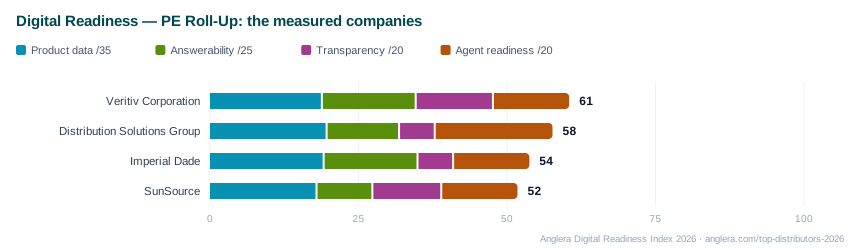
Stacked bars: the four pillars of the Digital Readiness Index — segment lengths are pillar scores, the number is the company's total out of 100.
Rank is this company's position in the full 2026 index; a dash means it did not disclose enough for us to rank it there, not that it is small. "Not sampled" means the company sits in this archetype but wasn't in the batch of catalogs we measured for the index — a scope decision on our end, not a finding about them.
How the model runs
The mechanics are consistent across all 29. A sponsor buys a platform, then bolts on smaller regional operators at a steady clip, and the acquired brand usually keeps its own name. Imperial Dade has closed 97 acquisitions since the Tillis family took control in 2007 under Advent International and then Bain Capital, a run that culminated on March 12, 2026 in a merger with BradyPlus — a $2.8 billion JPMorgan term loan financed the combination, which unified under the Imperial Brady name in May 2026 and now runs 125+ facilities and 13,000+ employees under one $10B+ roof. North American Plastics has taken the model further: it publicly rebranded as "Plastics Family Americas" this year specifically to disclose 40+ owned distributor brands, from Polymershapes to Laird Plastics, under one federated identity, while every brand keeps trading under its own name across 200+ locations, up from 115 in the FY2021 MDM listing. Cadence Petroleum Group closed five named acquisitions in the 2025–2026 window alone — R.W. Davis Oil, B-J Supply, Glockner Oil, BOC Oil, and SEI — folding legacy family-run fuel distributors into a 34-location, 22-state footprint.
What that buys is straightforward: geographic density a single operator would take a decade to build organically, purchasing leverage with suppliers, and enough scale to win national-account business that no regional player could service alone. What it costs is working capital and debt tolerance — the Imperial Dade/BradyPlus deal needed a $2.8 billion loan — plus a standing M&A and integration function that never really stops running. Distribution Solutions Group shows where that function eventually points inward: built from three separate operating companies (Lawson Products, TestEquity, Gexpro Services) through bolt-ons like TestEquity's 2024 ConRes carve-out, it is now itself being taken private by its own ~79% owner, LKCM Headwater, for $35.00 a share — an 81% premium, and a reminder that the sponsor doing the consolidating can also be the next thing consolidated.
The tension
Keeping an acquired brand's name intact is good business — it preserves the local sales relationships and reputation the sponsor just paid for. It also means the roll-up, almost by design, doesn't end up with one system, one item master, or one place a buyer or a crawler can go to see what the whole company sells. That tension shows up in this data more starkly than in any other archetype: three of the 29 companies here — Applied Adhesives, Cadence Petroleum, and LGG Industrial — came back "no public catalog," and four more — US LBM, North American Plastics, OTC Industrial Technologies, and Singer Industrial — looked that way until an adversarial verification pass found live public product pages inside the brand family, usually on an owned banner storefront; those four now read "not yet measured (catalog verified live)" and carry no score this edition. US LBM's corporate site is still brochure and recruiting content spread across roughly 48 separate locally branded building-materials sites — the public catalog we found lives on one of its banners, Higginbotham Brothers. Applied Adhesives' site is consultative, organized by chemistry and market segment, with no product-level pages to sample. That isn't a defect in any one company's website — it's the direct, structural consequence of the model's central bet: that brand equity is worth more than a shared front end.
What the index found
The Digital Readiness Index has a published score for only 4 of these 29 companies. Imperial Dade scored 54, Veritiv 61, SunSource 52, and Distribution Solutions Group 58 — a median of 56, just under the 58 median across the entire index. On four companies that's proximity worth noting rather than a pattern worth trusting; it at least argues against assuming a roll-up structure is inherently punishing for product data, but it's not enough to claim the model helps either. Two more roll-ups, QXO and BradyPlus, came back "not observable" rather than scored — QXO's own product pages are public and crawlable with no login wall, per our notes, but neither site renders to our standard measurement client, so no rule-compliant sample exists yet. That's a limit of what we could observe on those particular platforms, not a statement about what QXO or BradyPlus publish.
Within the four measured companies, product data depth is the consistently strong pillar — all four land between 18 and 19.8 of 35 — but commerce transparency is where they split. Imperial Dade and Distribution Solutions Group both showed 0% public pricing across their five sampled products; SunSource showed 40%, Veritiv 50%. That's a normal pattern for trade-account distributors where a login gates price, not a red flag on its own, but it's also the reason none of the four broke 61. Identifier discipline is where the real spread sits: Imperial Dade's sample carried GTINs on 80% of products, against 0% for Veritiv, SunSource, and Distribution Solutions Group alike — one company solved a problem the other three, despite running comparable operating models, have not. And the more damning number, per the sample, belongs to SunSource: a 24-point consistency spread between its richest and thinnest product page, triple Imperial Dade's 8-point spread, on a single storefront rather than across a scattered brand family — evidence that even a roll-up that did consolidate onto one platform can still treat its own SKUs unevenly.
None of these four scores is a verdict on the company behind it — each is a read of five pages sampled from the middle of a catalog on a given day in 2026, and a business mid-integration this year can look different next year. What the roll-up archetype adds that the other five in this index don't is a second axis entirely, sitting in front of the score: whether there was a single catalog to sample from at all. For three of the 29 distributors that built their scale this way, there wasn't, and for four more the catalog only surfaced one owned banner deep — not because the products don't exist, but because the entity that reports the revenue and the dozens of entities a customer actually buys from are still, deliberately, not the same system.