
The Catalog-Natives: How 13 Distributors Win on Data Alone
Thirteen distributors sell self-serve from massive catalogs instead of sales reps. Only four were scored, and the archetype's median sits below the index-wide median.
Part of Top Distributors 2026 — the Anglera Index: North America’s largest distributors ranked, classified into six operating archetypes, and scored on the measured Digital Readiness Index.
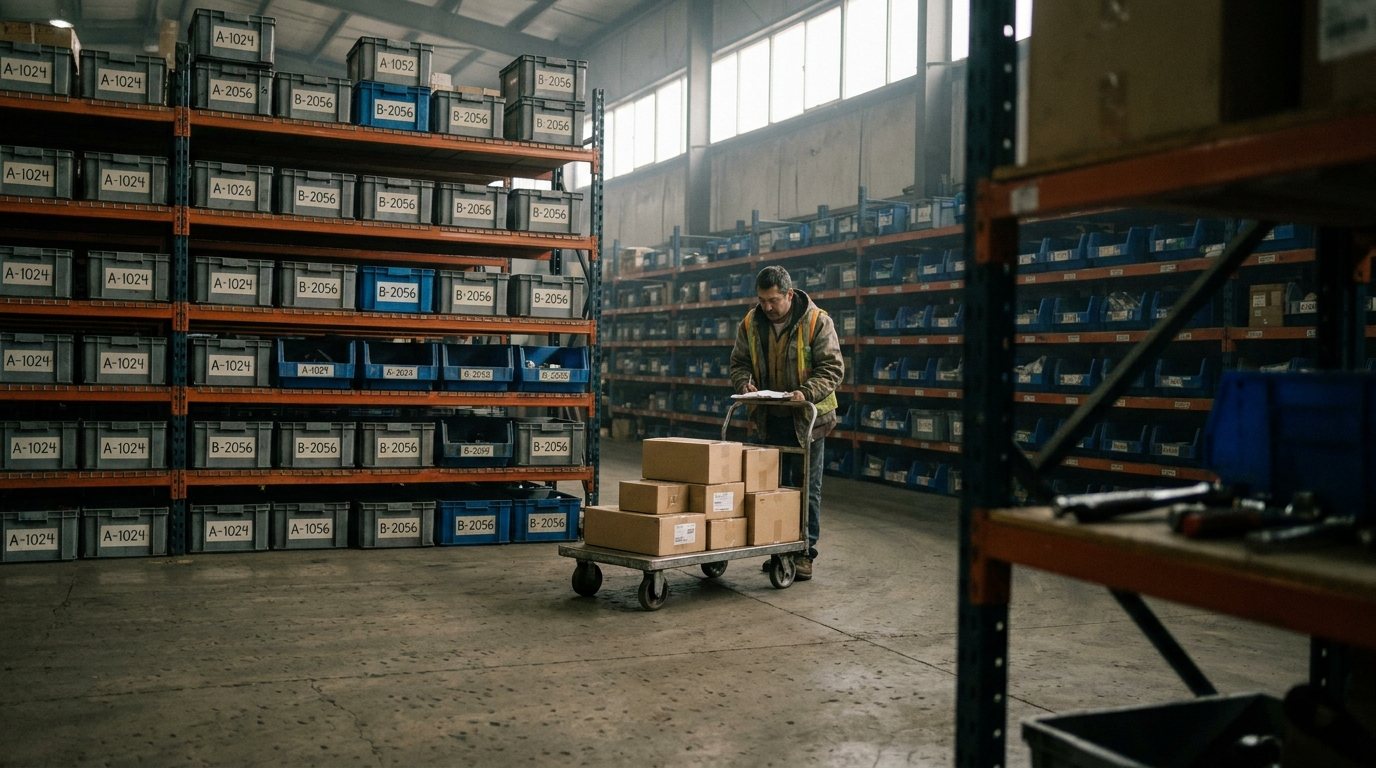
McMaster-Carr has no sales phone number worth calling. Its category pages carry a full spec table and an "Add to Order" quick-view for every SKU in a family, reachable with no login, and that page is the entire sales interaction. That is the catalog-native model in one screenshot: breadth, depth, and self-serve fulfillment doing the job a rep would do everywhere else in distribution.
The roster
Thirteen companies in this cut run some version of that model, at wildly different scales and under wildly different ownership structures. Four were measured on the Digital Readiness Index — one of them, Uline, in a full browser session because its site can't be read by standard clients; the rest either weren't part of this round's sample or don't publish a catalog the index can read.
| Company | Rank | Revenue | DRI Score |
|---|---|---|---|
| Thermo Fisher Scientific | 7 | $44.6B (FY2025) | 59 |
| Uline | 36 | $8.1B (est.) (CY2025, est.) | 56 |
| ADI Global Distribution | 54 | $4.78B (FY2025, segment) | — |
| DigiKey | 63 | $3.96B (FY2025, est.) | 53 |
| Global Industrial Company | 90 | $1.38B (FY2025) | — |
| RS Group (Americas) | 92 | ~$1.09B (FY2026, NA) | — |
| Berkshire Tool Supply Group | — | not disclosed | — |
| Interstate Plastics | — | not disclosed | 52 |
| McMaster-Carr | — | not disclosed | — |
| Mouser Electronics | 61 | $4.1B (FY2022, dated) | — |
| Professional Plastics | — | not disclosed | — |
| ThyssenKrupp Engineered Plastics | — | not disclosed | — |
| D&H Distributing | 42 | ~$7.0B (FY2025) | — |
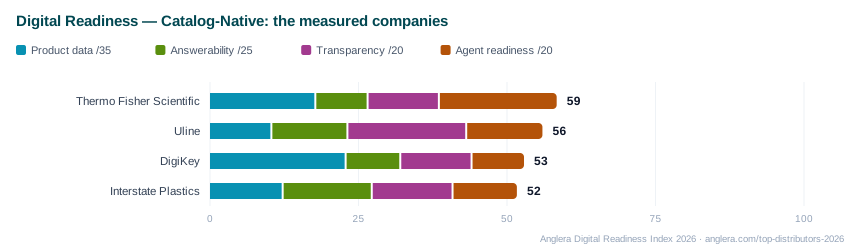
Stacked bars: the four pillars of the Digital Readiness Index — segment lengths are pillar scores, the number is the company's total out of 100.
How the model actually runs
The tell that separates catalog-natives from everyone else in this index isn't size, it's the absence of a rep in the loop. DigiKey ships same-day from more than 17.5 million components across nearly 3,000 manufacturers with nobody picking up a phone to quote a price. Mouser stocks more than 1.2 million SKUs with no minimum order quantity, competing deliberately for the low-quantity prototype order that a rep-driven distributor can't fill profitably. RS Group runs an 830,000+ product searchable catalog as its core operating asset in the Americas. Even a master distributor like Berkshire Tool Supply Group, which sells through independent resellers rather than directly to end buyers, builds its whole proposition on a roughly two-million-SKU digital catalog running on a punch-out e-commerce platform.
What that buys is scale without headcount. Search and filtering aren't a website feature bolted onto a sales operation, they're the product — which is why Thermo Fisher's Fisher Scientific channel, DigiKey's parts finder, and McMaster's family pages all read less like storefronts and more like databases with a checkout button. What it costs is capital sunk into inventory breadth and fulfillment speed instead of sales headcount. Uline is mid-build on that trade right now: a new 1.25-million-square-foot distribution center opening in Plainfield, Connecticut this fall to serve New England, alongside a paused (not cancelled) Kenosha County, Wisconsin facility the company attributed to economic uncertainty. DigiKey is making the same bet globally, standing up an India subsidiary and a Bengaluru capability center in November 2025 to push headcount toward 300 there. The model scales by adding distribution centers and stocking capacity, not by adding quota-carrying reps.
The tension: breadth fights depth
A catalog with a million SKUs and a catalog with a hundred SKUs are not the same engineering problem, and the measured companies in this cut show the strain in different places. Interstate Plastics — recently acquired by Curbell Plastics, which kept its e-commerce platform running as the deal's stated centerpiece — posts a median of just 2 structured attributes per sampled product page. DigiKey, by contrast, posts a median of 34 attributes, the richest page-level data in this cut, but its own consistency spread of 29 points means some pages in the same catalog are far thinner than others. Breadth is the whole pitch of this model, and breadth is exactly what makes uniform depth hard to hold across a catalog that size. There's no rep to smooth over a thin page with a phone call — whatever is on the page is the whole answer a buyer gets.
What the index actually shows
This is where the data pushes back on the archetype's own reputation. Catalog-native distributors are the companies the rest of the channel points to as the standard for digital shelf quality, and McMaster-Carr's rationale in this data set calls it "the industry's widely-cited reference standard." But only four of the thirteen were measured — Thermo Fisher Scientific, Uline, DigiKey, and Interstate Plastics — so this is a read on four companies, not thirteen, and it should be held loosely. Their median score is 56, against an index-wide median of 58. On this specific yardstick, at this sample size, the catalog-native leaders in this cut are not outperforming the rest of the index; they're running slightly behind it.
The more useful pattern is that none of the four clears all four pillars. Thermo Fisher posts a perfect 20 out of 20 on machine and agent readiness — full sitemap, structured product data, no crawler blocks — but its lowest score is buyer answerability at 8.8 out of 25. DigiKey's productData pillar leads the group at 23 out of 35, driven by that median of 34 attributes per page, but its agentReadiness pillar is the group's weakest at 9 out of 20, with no sitemap confirmed and no product structured data detected. Interstate Plastics inverts it again: its answerability pillar leads at 15 out of 25, its productData pillar trails at 12.4 out of 35. Uline is a fourth shape: a perfect 20 out of 20 on transparency, against the group's thinnest productData pillar at 10.5 out of 35 and a median of 6 attributes per family page. Each company is strong in the exact place the others are weak, which argues these are four different execution choices rather than one shared catalog-native profile.
One number is identical across all four: a GTIN rate of 0. None of the measured catalog-natives publish standard product identifiers on the pages sampled, which means the machine-readable part of "identifiers" inside the productData pillar goes unclaimed everywhere in this small sample, even on catalogs built specifically to be searched and compared.
The read
The catalog-native pitch has always been that the website replaces the salesperson. The Digital Readiness Index asks a narrower question: does the website also replace the paperwork a machine would otherwise need? On this cut's small measured sample, a catalog deep enough for a human to search comfortably isn't automatically a catalog structured well enough for a crawler or a shopping agent to parse — and the gap between those two things is where the next round of competitive separation in this archetype is likely to open up.