
The Program Suppliers: How 29 Distributors Win
29 distributors win by embedding in the customer's process via vending, VMI, and private label. Two got measured for digital readiness, and the split is instructive.
Part of Top Distributors 2026 — the Anglera Index: North America’s largest distributors ranked, classified into six operating archetypes, and scored on the measured Digital Readiness Index.
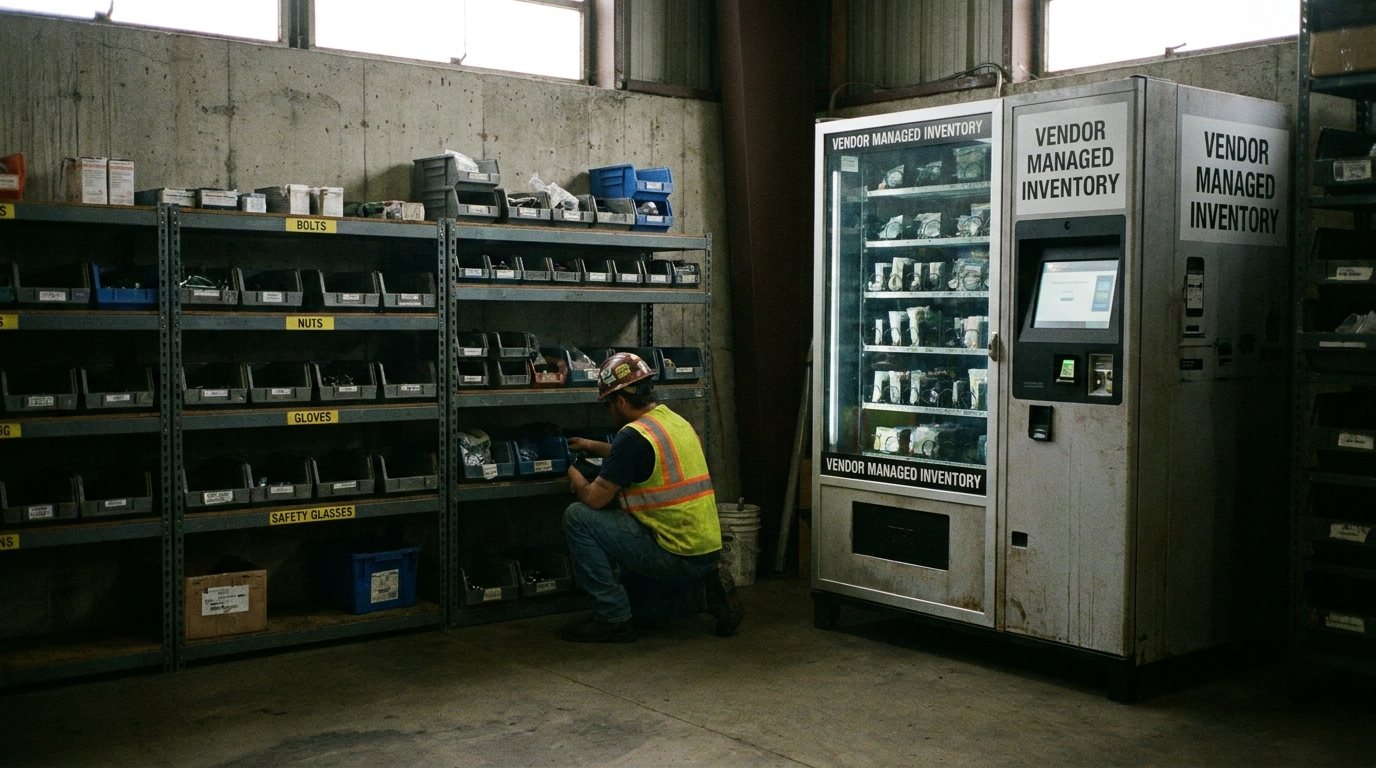
Fastenal has made zero acquisitions since 2018. In an industry where growth usually means buying share, that ought to be a problem. Instead the company is spending its 2026 capital budget on a new Atlanta distribution hub and more trucking and IT capacity to support vending and onsite growth — because Fastenal's unit of competition was never the transaction. It's the vending machine bolted to a customer's wall and the onsite rep sitting inside their four walls. That's the program-supplier model: win the process, not the order, and let the contract do the work a sales call used to do.
Twenty-nine companies in this index run some version of that playbook, from a $28.4 billion public healthcare distributor to family-owned fuel and fastener businesses that don't disclose revenue at all. What ties them together isn't size or category. It's the decision to compete on embedding rather than on price or catalog breadth.
The roster
| Rank | Company | Revenue (fiscal year) | Secondary model | Digital Readiness |
|---|---|---|---|---|
| 12 | Medline Industries | $28.4B | catalog-native | not measured (not observable) |
| 22 | Builders FirstSource | $15.2B | scale-aggregator | not yet measured (catalog verified live) |
| 24 | Henry Schein | $13.2B | catalog-native | not measured |
| 35 | Fastenal | $8.2B | branch-density | 55 |
| 65 | MSC Industrial Supply | $3.77B | catalog-native | 65 |
| 66 | NFI Industries | $3.6B (est.) | Program-supplier / scale-aggregator | not sampled |
| 68 | Guttman Holdings | $3.0B (est.) | Program-supplier / branch-density | not sampled |
| 83 | Vallen Distribution | $1.9B (NA, est.) | technical-specialist | not measured |
| 84 | Lonestar Electric Supply | $1.7B | branch-density | not measured |
| 85 | The Hillman Group | $1.55B | — | not measured (not observable) |
| 88 | Northern Tool + Equipment | $1.5B (est.) | catalog-native | not measured |
| 102 | AFC Industries | $700M | pe-rollup | not measured |
| 104 | Optimas OE Solutions | $577M | technical-specialist | not measured |
| 106 | Kimball Midwest | $565M | — | not measured |
| 118 | Rural Electric Supply Cooperative (RESCO) | $404M | Program-supplier / branch-density | not sampled |
| 123 | Loeb Electric | $300M+ (est.) | technical-specialist | not measured |
| 127 | Bossard (Americas) | $275M (approx.) (NA, est.) | technical-specialist | not measured |
| 132 | Field Fastener | ~$160M (est.) | technical-specialist | not measured |
| — | Arbill | not disclosed | technical-specialist | not measured |
| — | Boeing Distribution | not disclosed | — | not measured |
| — | EWIE Group | not disclosed | — | not measured |
| — | Great Lakes Petroleum | not disclosed | — | not measured |
| — | Incora | not disclosed | pe-rollup | not measured |
| — | Magid Glove & Safety | not disclosed | catalog-native | not measured |
| — | Parman Energy Group | not disclosed | branch-density | not measured |
| — | Port Consolidated | not disclosed | branch-density | not measured |
| — | Wholesale Electrical Supply Co. of Houston | not disclosed | technical-specialist | not measured |
| — | Würth Industry North America | not disclosed | branch-density | not yet measured (catalog verified live) |
| — | Total Safety Supplies & Solutions | not disclosed | Program-supplier / catalog-native | not sampled |
See the full 2026 index for every archetype and vertical cut.
How the model actually works
Every company on this list has the same tell somewhere in its story: vending-device counts, onsite location counts, VMI or integrated-supply contracts, or a private-brand manufacturing line reported as the growth metric that matters, ahead of same-branch sales or SKU count. MSC Industrial's stated strategy leads with vending-machine signings and in-plant program counts even though it also runs a multi-million-SKU catalog. Kimball Midwest runs almost no customer-facing branches at all — it operates a large outside sales force restocking maintenance bins directly inside customer facilities out of a handful of distribution centers, a route-based VMI business more than a counter business. EWIE Group manages roughly $300 million in customer-owned inventory across more than 2 million part numbers through tool cribs and onsite vending at 350-plus manufacturing sites. Field Fastener names "Data-Driven VMI Programs" and "Value-Added Engineering" as its two flagship offerings, ahead of sourcing.
The economics are straightforward once you see the pattern. A vending machine, a tool crib, or a rep who restocks your bins every week costs real money to install and staff, and it doesn't pay off on the first order — it pays off on the hundredth, after the customer has stopped comparison-shopping because switching now means re-engineering a process, not re-issuing a PO. Private label compounds the effect: Medline manufactures its own wound-care lines sold under CVS, Walgreens, Target, and Dollar General private labels while deploying roughly 2,000 direct sales reps into hospitals, pairing owned manufacturing with an embedded account relationship. Magid Glove & Safety runs the same play from a 700,000-square-foot Romeoville, Illinois plant, layering house-brand PPE onto distribution of 700-plus third-party safety brands. Once a distributor owns the product design and the on-site inventory, the buyer's actual alternative supplier is whoever is willing to redo both.
The freshest data confirms the model is still being built, not just defended. Würth Industry North America's Northern Safety & Industrial division acquired ORR Safety in 2025, explicitly to extend its private-label safety footprint into rail, automotive, and government accounts. The Hillman Group agreed to a $315 million deal for Kanebridge and bought Campbell Chain & Fittings from Apex Tool Group in April 2026, pushing toward a stated 2030 target of $2.5 billion in net sales built on in-store merchandising programs run by more than 1,200 field associates. Builders FirstSource bought off-site component manufacturer Innovative Construction Group from PulteGroup in August 2026 specifically to expand turnkey framing and wall-panel capacity — moving further from selling lumber and closer to running part of the builder's own construction process.
The tension
Embedding is expensive to walk back. A distributor that has staffed onsite locations, financed vending hardware, or stood up a private manufacturing line has committed fixed cost against a specific customer relationship, and that cost doesn't move if the customer's volume does. It also concentrates risk: Incora, which runs kitting, VMI, and integrated-supply programs across 68 locations in 17 countries for aerospace and defense customers, emerged from Chapter 11 in January 2025 after eliminating roughly $2 billion in net funded debt — a reminder that the same fixed infrastructure that creates switching costs for the customer also creates fixed obligations for the distributor, regardless of demand.
There's a second, quieter tension in the model: the deeper a distributor embeds in the account relationship, the less reason it has to invest in a public-facing catalog. If the rep restocks the bin and the contract sets the price, nobody is browsing a product detail page to decide what to buy. That shows up directly in this data.
What the readiness scores actually say
Only two of the 29 companies here were measured for the Digital Readiness Index (see the methodology for how the score is built): Fastenal, at 55, and MSC Industrial Supply, at 65. Everyone else falls into one of the model's structural gaps rather than a low score — though the gaps turned out to be smaller than they first looked. Builders FirstSource runs a real storefront at shop.bldr.com, and Würth Industry North America sells openly through its Northern Safety banner; both catalogs are verified live but not yet sampled, so neither carries a score this edition. Hillman Group's portal shows products freely but demands registration before it will show price or add-to-cart, and its pages are not observable to the standard measurement pipeline. None of that is a zero. Mostly it's a company leaning on the program relationship to do the selling instead of a browsable public catalog, which is close to the model working as designed.
With a sample of two, nothing here should be read as a verdict on the archetype broadly. But the two measured cases diverge in a way worth sitting with. MSC scores a full 20 out of 20 on commerce transparency — list pricing and add-to-cart are visible with no account required, with sign-in unlocking only negotiated rates — and posts a median of 25 structured attributes per page, more than double Fastenal's 11. Yet MSC's weakest pillar is buyer answerability, at 7.8 of 25, and its consistency spread is 25 points, the largest kind of number this index measures: some product pages are far richer than others in the same catalog. Fastenal's spread is a tight 6 points — its catalog treats products more uniformly — but that uniformity sits on top of a thinner base, and its weakest pillar is machine and agent readiness at 6 of 20, dragged down by a sitemap that doesn't reliably surface product URLs. Put simply: MSC's catalog is deeper but more uneven: Fastenal's is thinner but more consistent, and machine-discoverability is the softer spot for both. The archetype's median DRI of 65 sits above the index-wide median of 58, though with only two data points that gap is suggestive rather than conclusive.
The read
The program-supplier model doesn't ask a distributor to be good at the open web — it asks it to be good at one customer's four walls. The two companies here that did open their catalogs to measurement scored respectably, and their weak points, thin structured data at Fastenal, wide inconsistency at MSC, look like ordinary catalog debt rather than a model that structurally resists digital readiness. The more common story in this list is different: 27 of 29 companies carry no score — some not yet in the measured set, some with catalogs verified live but not yet sampled, and many with no public catalog a machine could read in the first place — because the contract is doing the job the catalog would otherwise do. That's not a gap in this index. It's the clearest signal in it about what these businesses actually are.