
Top Plastics Distributors 2026: A Roll-Up Outruns Its Data
Curbell just acquired Interstate Plastics, but the Digital Readiness Index scores the target higher than the buyer, and both trail a ten-branch acrylic specialist.
Part of Top Distributors 2026 — the Anglera Index: North America’s largest distributors ranked, classified into six operating archetypes, and scored on the measured Digital Readiness Index.
Curbell Plastics closed its acquisition of Interstate Plastics in April 2026, adding nine locations and a self-serve e-commerce catalog to a network that now runs 31 sites. On paper that reads as consolidation strengthening the buyer's digital shelf. The Digital Readiness Index says the opposite happened: Interstate Plastics scores a 52, two points ahead of the Curbell Plastics storefront it now reports into at 50, and both trail E&T Plastics, a ten-branch acrylic specialist that scores 68 while carrying a fraction of either company's catalog. Eleven companies make up this cut of the Top Distributors 2026 index. Only three carry a measured score this edition — a fourth has a verified live catalog awaiting sampling — and the order those three produce runs against the roll-up narrative building around them.
The ranking
| Company | Overall Rank | Revenue | Archetype | Digital Readiness Index |
|---|---|---|---|---|
| Tricon Energy | 23 | $14.0B (FY2025, est.) | Scale-aggregator | not sampled |
| North American Plastics (now Plastics Family Americas) | 97 | $1.0B (FY2021, dated) | PE Roll-up | not yet measured (catalog verified live) |
| Cope Plastics | 135 | $100M+ (FY2018, dated) | Branch-Density / Technical-Specialist | not measured (no public catalog) |
| Curbell Plastics | Not disclosed | not disclosed | Branch-Density / Technical-Specialist | 50 |
| E&T Plastics | Not disclosed | not disclosed | Branch-Density / Technical-Specialist | 68 |
| Interstate Plastics | Not disclosed | not disclosed | Catalog-Native / Branch-Density | 52 |
| Piedmont Plastics | Not disclosed | not disclosed | Branch-Density | Not in this round's sample |
| Polymershapes | Not disclosed | not disclosed | Scale-Aggregator / Technical-Specialist | Not in this round's sample |
| Professional Plastics | Not disclosed | not disclosed | Catalog-Native / Technical-Specialist | Not in this round's sample |
| ThyssenKrupp Engineered Plastics | Not disclosed | not disclosed | Catalog-Native | Not in this round's sample |
| Total Plastics International | Not disclosed | not disclosed | Branch-Density / Technical-Specialist | Not in this round's sample |
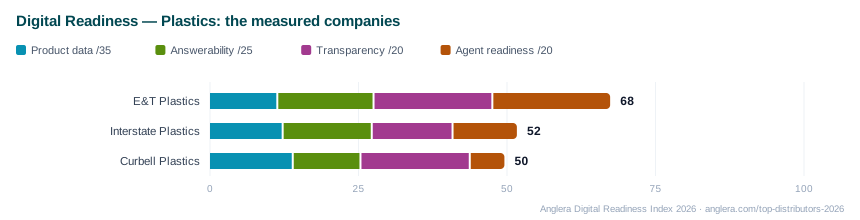
Stacked bars: the four pillars of the Digital Readiness Index — segment lengths are pillar scores, the number is the company's total out of 100.
Eight of the eleven companies here are privately held and disclose nothing. North American Plastics is the clearest exception because its FY2021 revenue of $1.0B was reported before its 2026 rebrand, and that rebrand is itself the vertical's biggest structural move: the company now trades as Plastics Family Americas, a holding brand sitting over more than 40 acquired distributor names — Polymershapes, Laird Plastics, Total Plastics, ePlastics, and Port Plastics among them — spanning 200-plus locations, up from 115 in that FY2021 filing. Its old domain now redirects to a corporate site with no catalog of its own, but a verification pass found live public product pages on its owned banners — ePlastics among them — so its status is now catalog verified live, not yet measured: it carries no Digital Readiness score this edition, since scores are only published from rule-compliant samples, despite being the only company here with a disclosed number to rank by.
Branch density, with a fabrication spine
Five of the eleven companies are classified branch-density: Cope Plastics, Curbell Plastics, E&T Plastics, Piedmont Plastics, and Total Plastics International. That is the plurality archetype, and it fits the product. Plastics distribution runs on sheet, rod, and tube stock that gets cut to a customer's dimension close to where the customer is, so branch count and cut-shop capability matter more here than in categories where a single DC can ship anywhere overnight. Six of the eleven — Cope, Curbell, E&T, Polymershapes, Professional Plastics, and Total Plastics International — carry technical-specialist as a primary or secondary tag, reflecting CNC routing, laser cutting, or custom fabrication layered onto the stock business. This is not a pure buy-and-resell category; the value-add is cutting and finishing, and the archetype mix says so plainly.
Three companies sit outside the branch-density norm and explain the vertical's consolidation story. Polymershapes is the scale-aggregator built for this category: one national brand across 85-plus centralized locations, and its 2026 moves (acquiring fabrication shop TuBro Company in January, expanding a Chihuahua nearshoring facility) both add engineering capacity rather than raw branch count, a different growth logic than the branch-density group. North American Plastics is the lone PE roll-up, and its move this year was consolidating disclosure rather than adding capability — folding dozens of already-owned brands under one federated name while leaving each brand's own storefront and identity untouched. Between them, Curbell's acquisition of Interstate Plastics sits closer to the branch-density playbook: trade press and the deal announcement both emphasized keeping Interstate's e-commerce platform running rather than folding it into Curbell's own systems, which is exactly why the two companies still carry two separate — and separately scored — storefronts today. The cut's other scale-aggregator, Tricon Energy, is new to this refresh and lists under MDM's combined "Plastics, Lubricants & Fuels" category — a $14.0 billion petrochemicals distributor whose scale comes from feedstocks and fuels, not the sheet-and-rod business the rest of this cut runs.
What the Digital Readiness Index found
The Digital Readiness Index samples five live product pages from five different categories of a company's own catalog and scores what a machine or a buyer can extract from them. This vertical's median score among the three measured companies is 52, six points under this index's overall median of 58.
The pillar breakdown explains why in different ways for each company. Curbell's product page is genuinely open — no login to browse, most SKUs priced directly — which is why its commerce transparency pillar hits 18.4 of 20. But its machine and agent readiness pillar collapses to 6 of 20: no Product schema markup on the pages sampled and a sitemap that didn't resolve cleanly, the kind of gap that keeps a page invisible to a shopping agent even when a human buyer can see the price fine. E&T Plastics inverts that pattern almost perfectly, scoring a full 20 of 20 on agent readiness with working schema markup and a clean sitemap, and a perfect 20 of 20 on commerce transparency with every sampled SKU priced. Its weak spot is product data depth at 11.5 of 35 — a function of how narrow the sampled catalog actually is, since every purchasable SKU in E&T's 140-product Shopify store is a variant of cast or mirrored acrylic sheet. Interstate lands in between on most pillars but posts the worst consistency spread of the three, 16 points between its richest and thinnest sampled page against 7 for Curbell and 5 for E&T — the clearest sign of a catalog still being unified after a change of ownership.
One number is identical across all three measured companies: a 0 percent GTIN rate. None of them exposes a barcode-level identifier on the sampled pages, and median attribute counts run thin everywhere — 5 for Curbell, 3 for E&T, 2 for Interstate. For a category where the actual buying question is "does this sheet come in 3/8-inch cast acrylic in a 48-by-96 size with a matte finish," that gap matters more than a missing barcode would. A buyer or an agent filtering by resin type, gauge or thickness, sheet dimensions, color, and flame or chemical rating needs those as structured fields, not prose in a description. At two to five attributes per page, none of the three measured catalogs currently supports that kind of filtering at any depth, which is arguably a bigger gap for this category than the identifier problem the GTIN number points to.
Where this goes next
The M&A activity in this vertical outpaces the digital investment behind it. Curbell folded in Interstate's storefront rather than its own, Polymershapes bought a fabrication shop instead of a catalog upgrade, and North American Plastics spent 2026 consolidating a holding-company identity over more than 40 brand names that still each run their own site. None of that shows up as a Digital Readiness gain, and the one company that scores best, E&T Plastics, does it by staying narrow rather than by winning a scale race. The buyers who show up in five years expecting to filter plastics inventory the way they already filter fasteners or electronics are going to find a category still organized around branch phone numbers and quote forms, Cope Plastics being the plainest example: its only calls to action are "Request A Quote" and a material selector tool that ends at a phone number, not a checkout.