
The Branch-Density Operators: How 70 Distributors Win Local
70 distributors win by being closest to the jobsite. How the branch-density model runs, its capital trade-off, and what its Digital Readiness Index scores reveal.

Part of Top Distributors 2026 — the Anglera Index: North America’s largest distributors ranked, classified into six operating archetypes, and scored on the measured Digital Readiness Index.
This is the largest archetype in the index by headcount. Seventy distributors, more than in any other operating model, compete primarily on proximity: a branch, a counter, and a relationship within a short drive of the buyer. Only nine of them have ever had a product page measured, which turns out to be a finding in its own right, not just a sampling limitation.
Twenty Minutes From the Jobsite
No company states the model more plainly than Winsupply. It runs more than 680 "Local Companies," each carrying real equity held by its own branch president, and each free to set local pricing and buy decisions without a corporate office signing off. Growth is reported the same way every year: not revenue per distribution center, but new Local Company openings, 20 of them planned for 2025-2026. It is the purest expression of a pattern that repeats across the roster. Consolidated Electrical Distributors runs over 700 "profit centers" on the same logic. Hajoca runs more than 450 of them under 60-plus retained regional trade names, each manager controlling local inventory, pricing, and hiring directly. The branch is not a cost center reporting up. It is the unit of the business.
That structure has a direct, awkward consequence for a project like this one: Winsupply has no single storefront to sample, because there isn't one — the corporate domain routes to individual local-company sites like "Newark Windustrial," each its own small brochure page. CED's own domain now redirects to an unrelated company and its commerce happens on dozens of independently branded local sites — though a verification pass found one of them, its solar arm Greentech Renewables, running a full national public catalog, verified live but not yet sampled for a score. Hajoca's homepage says outright that ordering happens through your local store, and the local stores mean it: their per-branch storefronts show public pricing and live branch stock, verified live but likewise not yet sampled. None of these are failures to build a catalog. They are the catalog behaving exactly the way a branch-owned business would: locally, not centrally.
The Roster
| Rank | Company | Revenue (FY) | DRI |
|---|---|---|---|
| 18 | ABC Supply Co. | $20.2B | not measured (no public catalog) |
| 31 | Motion (Genuine Parts Company) | ~$9.0B (segment) | 62 |
| 32 | Winsupply | $8.4B | not measured (no public catalog) |
| 49 | 84 Lumber | $5.9B | not measured |
| 51 | Consolidated Electrical Distributors (CED) | ~$5.5B (est.) | not yet measured (catalog verified live) |
| 55 | SiteOne Landscape Supply | $4.7B | not measured |
| 67 | Reece USA | $3.3B (NA) | 51 |
| 72 | F.W. Webb | $2.6B | 65 |
| 73 | TopBuild (Specialty Distribution) | $2.52B (segment) | not measured |
| 77 | Gulfeagle Supply | $2.2B (est.) | not measured |
| 78 | Elliott Electric Supply | $2.12B | not measured |
| 87 | Lansing Building Products | $1.5B (est.) | not measured |
| 93 | Main Electric Supply Co. | just under $1.1B | not measured |
| 94 | Bearing Distributors Inc. (BDI) | $1.0B | 58 |
| 95 | Richards Building Supply | $1.0B (est.) | not measured |
| 101 | Locke Supply Co. | $738M | not measured |
| 112 | Arc3 Gases | $500M+ (est.) | 43 |
| 116 | Inline Electric Supply | $456M | not measured |
| 117 | Bisco Industries | $427.9M | not measured |
| 119 | nexAir | $400M (FY2022, dated) (dated) | not measured |
| 121 | Edges Electrical Group | $360M (dated) | not measured |
| 122 | Granite City Electric Supply | $335M | not measured |
| 124 | United Electric Supply | $300M+ (dated) | not measured |
| 126 | Martin Supply | $279M+ | not measured |
| 130 | Roberts Oxygen Company | ~$220M (est.) (est.) | not measured |
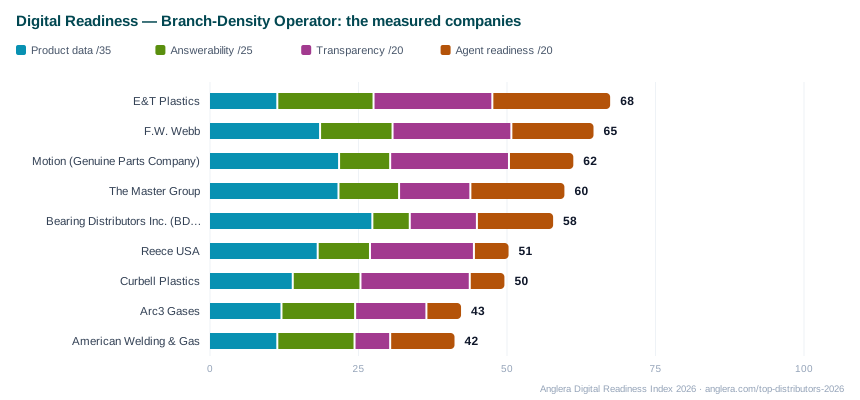
Stacked bars: the four pillars of the Digital Readiness Index — segment lengths are pillar scores, the number is the company's total out of 100.
Thirty-two more branch-density operators sit in the full Top Distributors 2026 index without a numeric rank, private companies that do not disclose revenue at all — E&T Plastics, Curbell Plastics, and American Welding & Gas among them. Their absence from a revenue ranking is not a comment on their size; several run more locations than half the companies above.
How the Model Runs
The mechanics are consistent across the roster regardless of category. Growth gets reported in branch count, not SKU count: Elliott Electric Supply describes its strategy as "building, not buying," and backed it with a first Carolinas branch in Charlotte and a $5M San Antonio expansion in 2025. F.W. Webb has a new Somerdale, NJ location planned for 2026 on top of its existing 100-plus branches. 84 Lumber opened a new La Mirada, CA store in January 2026 specifically to help supply Palisades-fire rebuilding — the kind of hyperlocal, event-driven opening that a centralized DC network can't replicate on a two-week timeline. Wholesale Electric Supply opened five new branches in 2025 alone and credits them for 12% revenue growth.
M&A shows up constantly in this cut too, but it works differently than in a roll-up. Richards Building Supply's April 2026 purchase of United States Building Supply added four Colorado branches and, notably, its first entry into the Western US — acquisition as a way to add density in a new territory, not to consolidate an existing one. SPI Health and Safety has made 24 acquisitions since 1972 and still runs only 18 locations, folding small operators in one at a time rather than centralizing them. Arc3 Gases has done the same with small welding shops across seven states, adding its 59th and 60th locations in 2025 alone. The acquired unit typically keeps its counter, its local name recognition, and often its staff. What changes is the balance sheet behind it.
The Working-Capital Tax
Every one of those openings is a real-estate lease, a local inventory position, and a counter staff — capital that a centralized-warehouse competitor doesn't tie up the same way. That is the honest trade embedded in the model, and it scales in both directions. The most extreme case in the roster is SRS Distribution, which Home Depot bought in 2024 and which then bought GMS for roughly $5.5B in September 2025, pushing the combined network past 1,250 locations. Home Depot deliberately kept SRS running as "a family of distinct local brands" rather than folding it into one national banner — proof that even a trillion-dollar-market-cap parent believes the branch relationship is worth preserving, not proof that the model becomes cheaper to run once it has that kind of backing. Home Depot Pro's own storefront is not observable to this measurement's standard pipeline — its homepage sits behind Register Now / Log In prompts even though the product pages themselves are public — a reminder that capital doesn't automatically buy a catalog a machine can read even when it buys 1,250 branches.
What the Catalog Says When Nobody's Watching
Nine measured companies out of 70 is a small enough sample that any pattern here should be read as a lead, not a verdict. Their median Digital Readiness Index score is 58 — respectable, and squarely mid-pack against the wider index.
The pillar breakdown, four subtotals covering product data depth, buyer answerability, commerce transparency, and machine and agent readiness, is where the model's fingerprint shows up. Product Data Depth, worth 35 points, is the soft spot almost everywhere in this group. BDI leads it at 27.5, with a median attribute count of 34 per page — genuinely deep. Everyone else measured comes in under 22, and four of the nine — Arc3 Gases, American Welding & Gas, Curbell Plastics, and E&T Plastics — score below 15, with median attribute counts of 6, 6, 5, and 3 respectively. None of those four carry a GTIN on a majority of sampled pages either. That is consistent with an operating model where the person who resolves "is this the right part" is a branch employee on the phone, not a taxonomy behind the search bar — the branch relationship substitutes for machine-readable identity rather than needing it.
The highest score in the group, 68, belongs to E&T Plastics — but not because its catalog is deep. Its product-data pillar is actually one of the weakest in the sample (11.5), because the whole public catalog is 140 SKUs of acrylic sheet. It wins on Buyer Answerability (16.2 of 25) and a clean sweep of Machine & Agent Readiness (20 of 20 — sitemap, structured data, and open crawler access all present). A narrow catalog, done consistently, scores better than a broad one done unevenly. Motion is the clearest case of the opposite problem: solid Product Data Depth (21.9) and full marks on Commerce Transparency, but a consistency spread of 45 points between its richest and thinnest sampled page — the widest in the whole cut — despite running on a single, unified motion.com storefront. Consolidation of the front end hasn't consolidated the underlying data discipline.
The Read
Branch density is not a digital strategy, and none of the nine measured scores here suggest the companies running it think of it as one. It is a real-estate and staffing strategy that happens to leave a thin, uneven layer of product data behind it — good enough for a buyer who already trusts the counter, thinner than what an AI agent sourcing on that buyer's behalf will be able to work with. The two things that make this model expensive to copy, a lease in every territory and a local reputation built branch by branch, are exactly the two things a catalog page can't show.