
The Digital Readiness Index 2026: Scale Doesn't Predict Readiness
We sampled live product pages from 37 major distributors and scored identifiers, content, pricing and machine access. Revenue rank barely moved the needle.

Part of Top Distributors 2026 — the Anglera Index: North America’s largest distributors ranked, classified into six operating archetypes, and scored on the measured Digital Readiness Index.
Pick two product pages at random from Motion Industries' catalog and one of them is likely to carry up to 45 more structured attributes than the other. That's the widest spread we found anywhere in this round of the Digital Readiness Index, and it says more about how a distributor actually runs its catalog than its revenue ever will.
What we measured, and why the middle of the shelf
For each distributor we pulled five live product pages from five different categories of their own public catalog, always from the middle of the category listing, never a featured or promoted item. Featured products are a distributor's best foot forward; the middle of a category is what a buyer, or an AI shopping agent, actually lands on most of the time. We scored each sample against 100 points spread across four pillars: Product Data Depth, Buyer Answerability, Commerce Transparency, and Machine & Agent Readiness. The full scoring rubric, including how silence on AI crawler access is treated as permission rather than a penalty, is in the methodology. This piece covers 32 of the 37 companies we were able to fully measure this round, out of the larger Top Distributors 2026 index.
The leaderboard
| Rank | Company | Archetype | DRI Score | Median Attributes | Consistency Spread |
|---|---|---|---|---|---|
| 7 | Thermo Fisher Scientific | Catalog-native | 59 | 13 | 22 |
| 10 | Ferguson | Scale-aggregator | 58 | 0 | 0 |
| 16 | Gordon Food Service | Scale-aggregator | 65 | 2 | 2 |
| 19 | Sonepar (North America) | Scale-aggregator | 62 | 9 | 8 |
| 20 | W.W. Grainger | Scale-aggregator | 66 | 47 | 14 |
| 25 | Graybar | Scale-aggregator | 51 | 16 | 15 |
| 29 | Imperial Dade | PE roll-up | 54 | 11 | 8 |
| 30 | Dole plc (North America) | Scale-aggregator | 41 | 5 | 1 |
| 31 | Motion | Branch-density | 62 | 34 | 45 |
| 35 | Fastenal | Program-supplier | 55 | 11 | 6 |
| 39 | Core & Main | Scale-aggregator | 63 | 11 | 11 |
| 40 | Airgas | Scale-aggregator | 46 | 4 | 9 |
| 41 | Watsco | Scale-aggregator | 62 | 47 | 29 |
| 50 | Veritiv Corporation | PE roll-up | 61 | 18 | 12 |
| 63 | DigiKey | Catalog-native | 53 | 34 | 29 |
| 65 | MSC Industrial Supply | Program-supplier | 65 | 25 | 25 |
| 67 | Reece USA | Branch-density | 51 | 9 | 13 |
| 72 | F.W. Webb | Branch-density | 65 | 16 | 21 |
| 79 | DXP Enterprises | Technical-specialist | 48 | 11 | 10 |
| 81 | SunSource | PE roll-up | 52 | 15 | 24 |
| 82 | Distribution Solutions Group | PE roll-up | 58 | 17 | 14 |
| 89 | TricorBraun | Scale-aggregator | 70 | 14 | 4 |
| 94 | Bearing Distributors Inc. | Branch-density | 58 | 34 | 22 |
| 100 | The Master Group | Branch-density | 60 | 19 | 5 |
| 112 | Arc3 Gases | Branch-density | 43 | 3 | 2 |
| 120 | WPG Americas | Scale-aggregator | 60 | 3 | 2 |
| 136 | DH Sutherland | Technical-specialist | 47 | 4 | 1 |
| — | E&T Plastics | Branch-density | 68 | 3 | 5 |
| — | EIS Inc. | Technical-specialist | 60 | 18 | 24 |
| — | Interstate Plastics | Catalog-native | 52 | 2 | 16 |
| — | Curbell Plastics | Branch-density | 50 | 5 | 7 |
| — | American Welding & Gas | Branch-density | 42 | 6 | 12 |
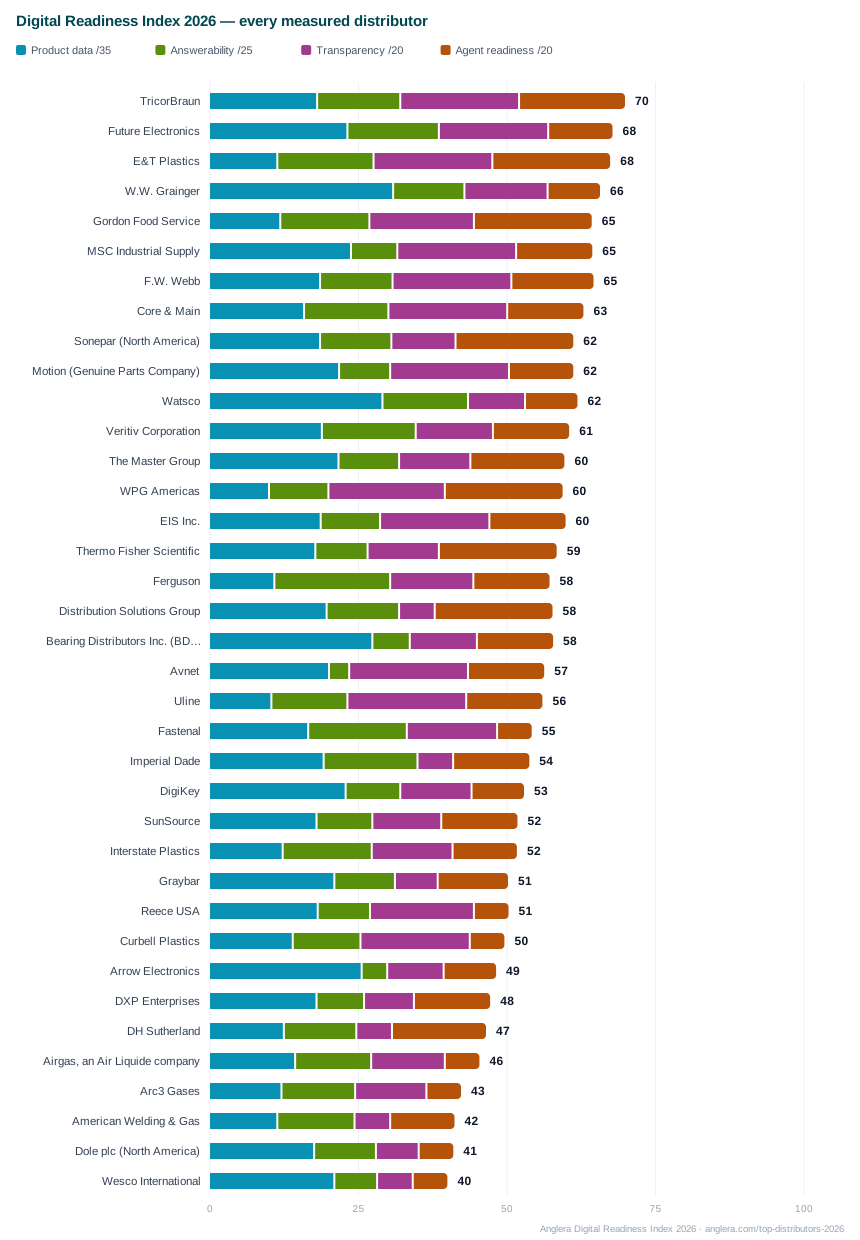
Stacked bars: the four pillars of the Digital Readiness Index — segment lengths are pillar scores, the number is the company's total out of 100.
What the spread actually shows
The median score across the group is 58, and the mean is close behind at 56 — a tight cluster, with the real story in the tails and in the pillar breakdowns rather than the overall number. The gap between the top score (TricorBraun, 70) and the bottom (Dole, 41) is 29 points, which sounds modest until you notice that most of that gap comes from the same two sub-scores, over and over: identifiers and structured content.
Only 13 of the 32 companies attach a GTIN to any product in their sample, and identifier coverage doesn't track the leaderboard the way you'd expect. Five of the six highest scorers this round — TricorBraun, E&T Plastics, Grainger, F.W. Webb, and Gordon Food Service — return a 0% GTIN rate across their entire five-page sample. They're winning on pricing transparency, crawlability, and sitemap discipline, not on identity. That matters for a specific, narrow question a buyer or an agent actually asks: is this the same physical part a competitor is also selling? Without a GTIN or a comparable identifier, the honest answer a crawler can give is "unknown," no matter how clean the rest of the page is.
The median product page in this sample carries 11 structured attributes, but that median hides an enormous range. Grainger and Watsco both post a median of 47 attributes per page — the deepest catalogs we measured, by a wide margin — while Ferguson's five sampled pages returned a median of zero, and a consistency spread of zero too, meaning none of the five had any. That's despite Ferguson posting the second-highest Buyer Answerability score in the group (19.5 of 25): the pages read well to a person, with photos, specs, and reviews, but return almost nothing a filter or an agent can parse as structured data. Ask "will this fit a 3/4-inch NPT connection" and a human reading the page can answer it; a machine reading the same page currently cannot.
Consistency spread is the number that should worry a catalog owner more than any single score. Motion's 45-point swing means an agent sampling one category might conclude motion.com is one of the best-documented catalogs in distribution — which, in places, it is — and then hit a different category on the same site and find a fraction of the detail, with no way to predict in advance which one it'll get. Motion isn't alone: Watsco (29), DigiKey (29), and MSC (25) all post double-digit spreads while still scoring well overall. High spread travels with high scores about as often as it travels with low ones, which suggests depth and consistency are two different problems, and most of the group has solved only the first.
Zoom out past the 37 measured companies and the picture gets starker. Of the 78 large North American distributors we attempted to measure this round, 17 run no public product catalog we could find at all — pharmaceutical giant McKesson among them, alongside building-products players like ABC Supply and dozens of smaller specialty distributors whose entire ordering flow sits behind a login or a phone call. Another 16 — including Cencora, Cardinal Health, and Builders FirstSource — turned out to have live public product pages after all, usually on an owned banner storefront rather than the corporate domain; their catalogs are verified live but not yet sampled, so they carry no score this edition. Two more sites we could confirm have genuine public catalogs — Applied Industrial Technologies and R.E. Michel — but bot protection stopped us from sampling them cleanly, so they're marked not-verifiable, not scored zero. Six others, Medline among them, serve nothing readable even to a full browser session and are marked not observable — a limit of the measurement, not a claim about what sits behind the wall. (Arrow Electronics, Avnet, and Uline, whose sites also block standard clients, were measured this round in a full browser session instead, which their scorecards disclose.) None of those 41 companies has a digital readiness score, and none of the four statuses is a verdict on the business — only "no public catalog" says anything about the company itself, and even there it usually reflects a rep-driven or account-gated sales model that has worked for decades, not neglect.
Size didn't buy the top of the list
The two largest companies in this measurement by revenue, Thermo Fisher Scientific ($44.6B) and Ferguson ($31.3B), land at 59 and 58 — right at the group median. The top of the leaderboard belongs to TricorBraun, a packaging distributor whose most recent disclosed revenue is a stale FY2020 figure, and E&T Plastics, a ten-branch regional plastics distributor that doesn't disclose revenue at all. Between them they hold two of the top three scores. Revenue rank simply isn't doing much predictive work here: the businesses that show up in quarterly earnings calls are not, on this evidence, the ones building the cleanest digital shelf. A tightly run catalog looks like a deliberate, page-by-page decision, independent of how big the company behind it is.
What would move these numbers
None of what separates the top of this list from the bottom requires rebuilding a business. GTIN coverage doesn't need a new sourcing relationship — the identifier already exists on the manufacturer's side; someone just has to attach it consistently at the SKU level instead of leaving it blank on most categories. Closing a 45-point consistency spread means auditing the categories that get the least attention, not rebuilding the ones that already work. An AI crawler stance is a couple of lines in a robots.txt file, and the data treats silence as permission, not as a gap to apologize for — only an explicit block costs points. What the leaders in this list share isn't size or technical sophistication. It's that the tenth category in their catalog gets treated the same as the first.